Welcome:

Welcome to my world..............
Showing posts with label Butterflies. Show all posts

Thursday, 1 October 2020

What a year...

Following the very belated posting covering the computer crash through to the end of the year, who would have thought it could get worse....  In December I was diagnosed with esophageal cancer which caused a period of great uncertainty and putting annual subscriptions on hold; various scans suggested it was treatable and I was booked in for four sessions of aggressive chemotherapy.  Then as a vulnerable person I was on total self isolation with my family, with the general lockdown just before my last dose of chemo.  My operation due late April was cancelled and I was put on lower dose tablet chemo until my operation was rescheduled for mid June.  The op and subsequent recovery went extremely well and actually got back to work a month ago.

I just cannot use the excuse of not having enough time but it is a matter of priorities.  I used much of the lockdown time assembling an up-to-date Atropos magazine index, some 2600+ pages to scour, and having done most of it I just need to finish off, check it and format it.  I have re-labelled the Yorkshire Moth website photos in preparation for the planned update by MapMate to cope with the new numbering which is currently holding the website data updates back, 

Initially I was rather down about the prospect of just trapping at home, but I did manage some trapping at my private site at Brafferton (VC62) where I 'exercised' at night on my own, probably safer there than anywhere.  Following subsequent generator malfunctions I reluctantly started trapping on my parking spot at home in Langthorpe (VC65) and was pleasantly surprised at the results until wasp infestation brought things to a halt in September.

As a result of this rather fractured and stop/start recording this year, I will just just pick out the highlights to get back up to date.

The first period of trapping was 16 May to 1 June, 8 nights in total all at Brafferton VC62, with 1550 moths of 130 species.  Highlights were 95 Grey Pine Carpets, 53 Poplar Hawkmoths and 98 Orange Footman.  The best night was 20 May which was excellent for scarcer Ancylis moths with examples of the rare Ancylis laetana and Ancylis upupana, and Ancylis myrtillana well away from upland heath.

Ancylis laetana, Brafferton, VC62

 Ancylis upupana, Brafferton, VC62

Ancylis myrtillana, Brafferton, VC62

The second period at Brafferton was four visits 12 July to 2 August, 956 moths of 122 species.  The highlights and new for me in this period were a Monochroa cytisella, a bracken feeder rare in Yorkshire and only the 2nd record for VC62; a nationally scarce B Nemaxera betulinella probably only 2nd recent VC62 record; a Zeiraphera isertana a scarce oak feeder, and the scarce pine feeding Clavigesta purdeyi.

Monochroa cytisella, Brafferton, 7 Jul 2020 

 
Nemaxera betulinella, Brafferton, 25 Jul 2020

Zeiraphera isertana, Brafferton, 18 Jul 2020

Clavigesta purdeyi, Brafferton, 30 Jul 2020

Following reliability issues with both generators I reverted with reluctance to trapping at home.  I trapped 14 nights between 6 August and 19 September, catching 821 moths of 115 species.  This was considerably more than I had trapped in the previous 13 years there, so unsurprisingly I added 71 new species to the garden list.  Most were the expected common species, but it was great to get 11 confirmed and obvious Willow Ermine 6 - 14 August, and best of all was a micro new to Yorkshire, Metalampra italica, not one but two specimens.

This Willow Ermine clearly shows the greyish cast to the cilia and main part of the wings, with a narrow white border to the outer edge of the wings.

Willow Ermine Yponomeuta rorrella, Langthorpe, 6 Aug 2020

The next was a huge surprise, very obvious and not difficult to identify.  As a species it has an interesting history in that it appeared in Devon for the first time in 2003, and has slowly spread to other counties in the south, with odd ones turning up as far north as Lincolnshire and Lancashire, it was to be expected in Yorkshire.  Metalampra italica was previously known only from Italy before occurring in Britain whereas another species, Metalampra cinnamomea, is more widespread in Europe, including France and so seemed to be a better candidate for turning up here.  Having let my first one go, the second was obviously on its last legs and died shortly after potting.  I have forwarded it to Harry for gen. det..  This is a species that the larva inhabits decaying oak, and as there are not that many oaks close to my garden I wondered whether they arrived in my neighbour's hardwood logs for firewood? 

Metalampra italica, Langthorpe, 14 Aug 2020

Metalampra italica, Langthorpe, 14 Aug 2020 (same as above individual)

Metalampra italica, Langthorpe, 20 Aug 2020 (different individual and moribund)


Trapping at Langthorpe becoming very uncomfortable in September with increasing numbers of wasps, on the last two occasions outnumbering the moths 10:1; fortunately they were very dopey and did not bother the moths or me.  I took the opportunity to set up my trap at my work premises nearby in Roecliffe (VC64) and was extremely fortunate to have another new species for me, a Tachystola acroxantha, new at least for the Harrogate DNS and quite a distance from the next nearest record...just 50 meters further north and it would have been new for VC65.  This adventive species originally from Australia and probably introduced on imported plants, was first found in Devon in 1908, and has gradually spread northwards.
Tachystola acroxantha, Roecliffe, 21 Sep 2020

Having spent many hours sat on my terrace while isolating, I was fortunate to see some reasonable birds and butterflies.  Birds included Common Tern, Red Kite, Yellow Wagtail heard, Lesser Whitethroat, nearby singing Corn Buntings, Tree Sparrows, probable breeding Yellow Wagtails and at least one Hobby and a Blue-headed Wagtail. A good selection of common butterflies including several sightings of Holly Blue.  Finally a couple of other photos just to show it has not all been moths.

Comma, Brafferton, 19 Sep 2020

Common Darter, Nosterfield, 20 Sep 2020

What will the rest of the year bring and what can one hope to achieve in 2021?  At least I made it this far, and looking positively to the future.

Disaster recovery....!

It is obvious that I have neglected updating the blog and I am writing this in December 2019: following a mishap with a glass of milk and my laptop I have had a lot of catching up to do.  It was fortunate I had a fairly recent backup and in getting a replacement laptop I have spent a couple of months reconfiguring it and restoring as much as I could.  I don't think I have lost much data June/July, most re-entered from paper records, and a small number of photos are gone, fortunately the most significant already saved elsewhere.  A far more strict backup regime will be in place from now!

Botany themed meeting walks at Swillington Ings and South Gare added dozens of plant species, more moth trapping at Brafferton and a night at Ashberry NR both in VC62, a Shieldbug and Grasshopper course at Formby on a stormy Saturday still produced the goods, and casual day visits to Brafferton and Pilmoor.  Rather than add a lot of text I will just provide a selection of photos from the last few months.

Green Tortoise Beetle

Brown Hawker

Ruddy Darter, newly emerged from exuvia

Small Copper

It was worth letting this horsefly bite me to get a photo of those amazing eyes!
Notch-horned Clegg

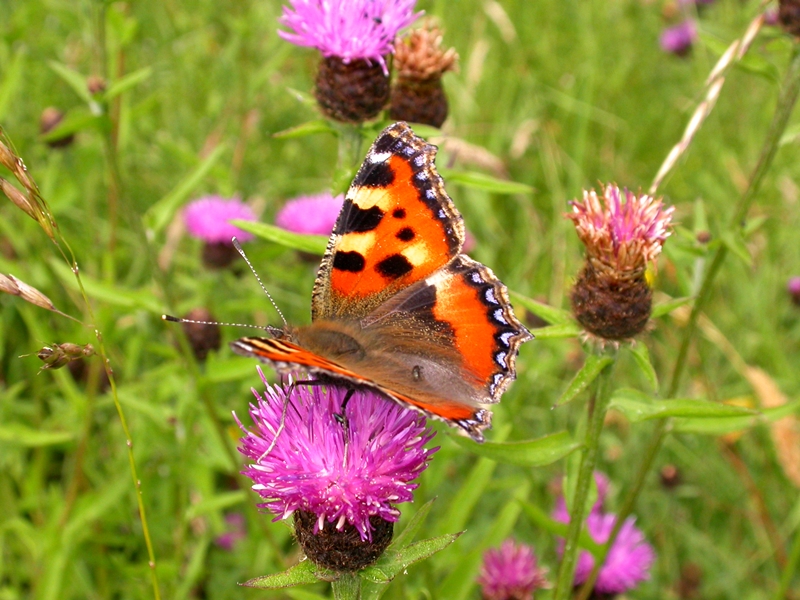
Small Tortoiseshell

A fine portrait of one of my favourite damselflies.
Banded Demoiselle, male

Scorpion Fly

A couple of interesting micros at Ashberry Pastures NR (VC62), both scarce in the County.
Adela croesella

Ancylis achatana

Twin-spot Carpet

 The pale band near the tip of the antennae is diagnostic.
Bronze Shieldbug, late instar, Pilmoor

 This tiny weevil is only 5-6mm in length and closeup looks very distinctive.
Weevil sp.

Figwort Weevil, Brafferton, 7 Sep 2019

The following is an Ichneumon parasitic wasp, one of two individuals attracted to light on different days, and apparently new to Yorkshire.  Very little is known of the species, on what it preys or its full distribution; identification confirmed by Gavin Broad (one of the authors of the RES handbook on Ichneumon wasps)..
Himerta sepulchralis, Brafferton, VC62, 14 Sep 2019

Scarce Footman., Brafferton, VC62, 3 Aug 2019

Pine Hawkmoth, Brafferton, VC62, Aug 2019

Later in August I was lucky enough to catch up with a Maidens Blush, a southern moth moving northwards.  I had caught one earlier in the year which I glimpsed as it made a dash for freedom, so was pleased to catch another.
Maidens Blush, Brafferton VC65, 25 Aug 2019
Maidens Blush, Brafferton, VC62, 25 Aug 2019

Thursday, 30 May 2019

The last few days

Following the successful visit to Lancashire at the end of last week I stayed a bit more local for the early part of this week.  Several speculative visits to interesting habitat for plants produced the surprise of the week.  A look at a grassy bank with plenty of Kidney Vetch produced at least two small dark blue butterflies which size-wise indicated Small Blue.  I was then thrown when photographing the underside of one of them: it was white with black spots which I took to be indicative of Holly Blue.  Bearing in mind it is 15 years since I have seen Small Blue in Dorset I had forgotten that they had dark uppersides and white undersides with black spots.  On checking it was clear that I had in fact seen two male Small Blues at what turns out to be one of two sites in Yorkshire but the locations are not commonly known.
male Small Blue, Yorkshire

Small Blue to 2014 - Courtesy of Butterfly Conservation
.
Kidney Vetch
 A walk around at Greenhow produced several interesting sightings, including a very good candidate for Mountain Pansy.
Mountain Pansy
I then visited Old Glebe fields near Leyburn looking for Burnt-tip Orchid, no luck on this occasion but good to see so many Green-winged Orchids even if they were past their best, and a few Twayblades, and several Water Avens. 
Greater Twayblade
Water Avens
On Wednesday I went looking for Argent & Sable moths at Bishop's Wood near Selby.  I eventually had at least seven in flight and eventually one perched on White Campion, even if it didn't pose properly!  
Argent & Sable, Bishop's Wood
Another speculative visit to interesting habitat in VC64 produced another surprise: Pasque Flower.  This is a plant I have seen before in Gloucestershire I think but never realised they occurred this far north.  In addition there were a small number of Fragrant Orchids coming into flower and at least 150 Chimney Sweeper moths, a species I had recorded in Dorset well before I was interested in moth recording and somehow hadn't made it on to my list.
Chimney Sweeper

Cocksfoot Moth

Fragrant Orchid
A fantastic weeks recording with c.70 new species including four new moths.


Thursday, 2 August 2018

Some days out and about

During July I took the opportunity to spend a bit of time out and about visiting sites I would not normally go to.  In a week off in the 2nd week of July I visited a very breezy Fen Bog on the North Yorkshire Moors to see Large Heath and Small Pearl-bordered Fritillaries, and also Keeled Skimmers.
Keeled Skimmer

Small Pearl-bordered Fritillary
The following day I headed south into Lincolnshire armed with a map and directions for a completely different site, something I didn't realise until I arrived at Chambers Farm Wood and couldn't make head nor tail of it.  With no site directions or anyone to ask I walked off into the wood and found a likely clearing and lucked in on at least two tree-top Purple Emperors, at least five White Admirals and dozens of high-flying Purple Hairstreaks.  There were probably hundreds of Ringlets along the rides, and a casual search of a Field Maple provided a mine of an Ectoedemia louisella, a new moth for me.
Ectoedemia louisella

Purple Hairstreak (with damaged wing)

White Admiral
Later that same week I attended a Field Studies Centre course at Preston Montford on Fly Family identification and managed to see a new moth, a Meal Moth!
Meal Moth
At the end of the month I had the opportunity to visit Slapton Ley in Devon through work, and spent the night trapping at the north end of the reed-beds.  Despite competition from an almost full-moon, numerous ships with lights in the bay and Start Point lighthouse, I still managed a reasonable nights catch.  What a beautiful morning, two young Hobbies flying around over the reed-bed, a singing Cirl Bunting in a distant hedgerow and a few Sedge and Reed Warblers chuntering away in the reeds.  
Slapton Ley, Devon
The moth highlights at Slapton included one new micro Homoeosoma sinuella (a poor phone photo), a Phycitodes maritima based mainly on small size, and Webb's Wainscots and Eupoecilia angustana both of which I had seen before at Gunwalloe in Cornwall in 2010. Migrant Silver Y's were in evidence and at least half of them were of the very small form dwarfed by the others. 
Homoeosoma sinuella

Phycitodes maritima

49.111 Eupoecilia angustana
The next two are the same species, Webb's Wainscot, and show the extremes in the dark markings, the lower more uniform one had a beautiful pink dusting to the wings.  A Notable B species found mainly in reed-beds especially along the coast from Yorkshire and East Anglia, Kent along to Cornwall, North Somerset and South Wales.
Webb's Wainscot

Webb's Wainscot
A successful month with a handful of new species seen.