Welcome:

Welcome to my world..............
Showing posts with label Leaf-mines. Show all posts

Sunday, 24 October 2021

Several new ones

Back to reality after the great week away in Cornwall, with limited trapping at my work premises in Roecliffe, Boroughbridge, and several forays out looking at leaves for leaf-mines.  Although an industrial site, the works premises backs on to a small willow fringed pond, with open fields next to the River Ure, which tantalizingly marks the VC64/65 border.

Trapping site at work

Nine nights trapping at work in September produced small numbers of moths, 368 of 52 species, and three nights so far in October offered 67 of 29 species, but included several of interest of which two macros were new to me.

Juniper Carpet, Roecliffe, VC64, 18 Oct 2021

Sprawler, Roecliffe, VC64, 8 Oct 2021

I had wondered whether I had overlooked Juniper Carpet in the past but on seeing this one I was immediately struck by the distinct apical dashes.  I addition there were fairly late records of Blood-vein on 5 October and Light Emerald on 7 October.  

After a few days stuck in hospital in early October I just had to get out and walk locally in the pleasant Saturday sun on 16 October.  Probably the best find was two London Plane trees between Langthorpe and Kirby Hill (VC65) which held numerous mines of Phyllonorycter platani.

Phyllonorycter platani mine on London Plane, Langthorpe, VC 65, 16 October

Phyllonorycter platani mine on London Plane, Langthorpe, VC 65, 16 October

The same as above, underside.

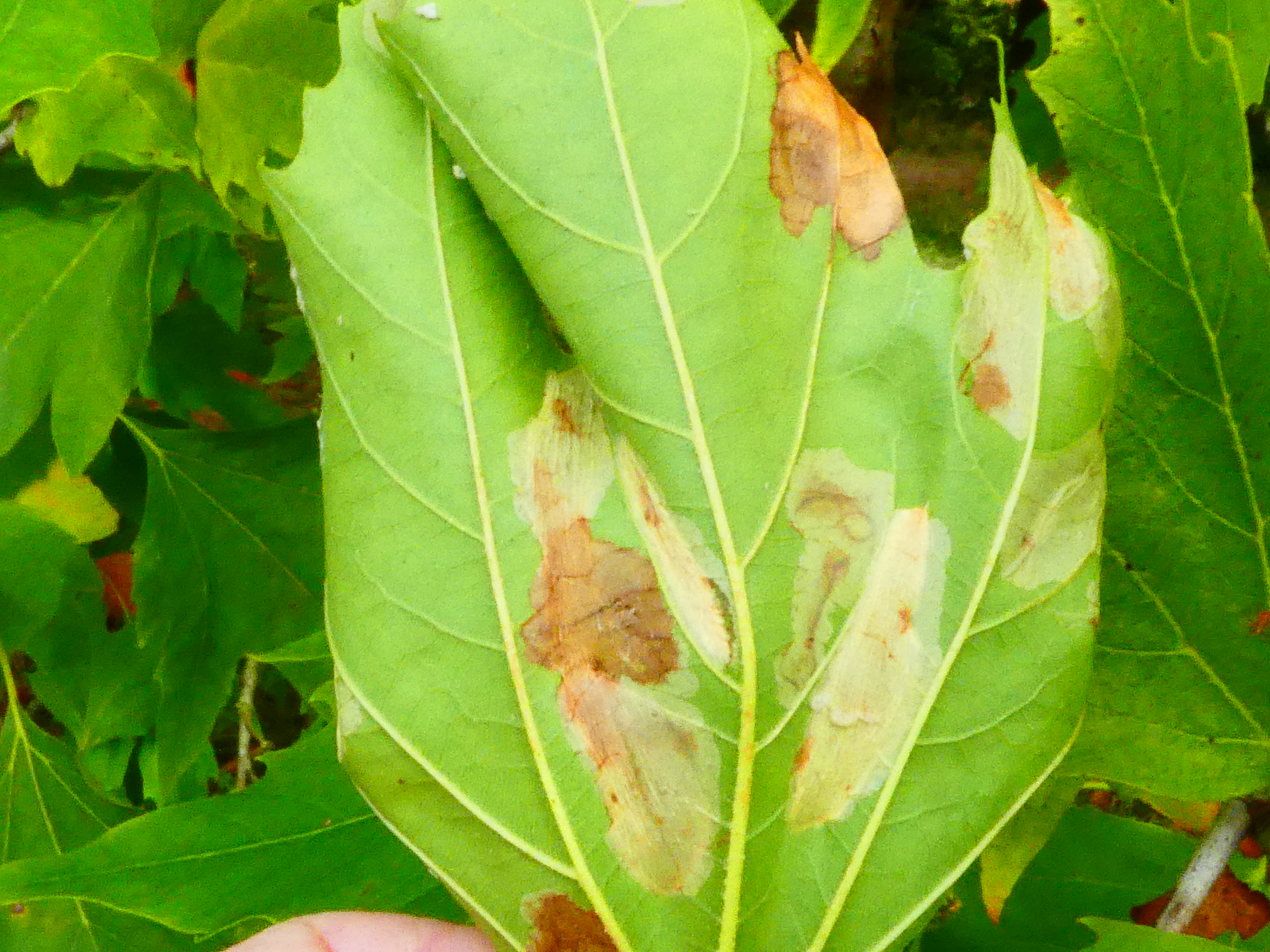
A casual stroll round the Yorkshire Arboretum on 23 October yielded a few leaf-mines.  The best was a few mines on Sweet Chestnut which were proper mines rather than the numerous Phyllonorycter messaniella blotches, and could only be Stigmella samiatella, a new one for me.  Common on oak where it needs to be bred through to confirm, it is thought to be the only Stigmella on Castanea.  The only other mines of interest were some more Phyllonrycter platani this time on Oriental Plane.

Stigmella samiatella mine on Sweet Chestnut

Stigmella samiatella mines on Sweet Chestnut

Phyllonorycter platani mines on Oriental Plane.

Phyllonorycter platani mines on Oriental Plane.

On checking the 30+ Sweet Chestnut at Allerton Park south of Boroughbridge VC64 there were probably several thousand Phyllonorycter messaniella blotches, but despite careful searching not one S. samiatella mine could be found.


Thursday, 2 September 2021

A week in Cornwall

Thanks to the generosity of my Brother-in-Law Kev and his partner Liz who arranged a week 21st - 29th August in a beachside cottage in Gorran Haven, Cornwall (VC2), I seized the opportunity to trap in Liz's nearby garden each night.  The weather was fabulous during the day with mainly wall-to-wall sunshine, the clear skies and large moon affected the catches overnight; the one cloudy night on 26th August gave the best results with 154 moths of  52 species.


The catches were fairly modest but did provide me with three new species and a selection of southern species which I haven't seen since leaving Dorset in 2006.  The new species were Azalea Leaf Miner Caloptilia azaleella, Lobesia littoralis and a Jersey Mocha Cyclophora ruficiliaria, while those that I had seen before when living down south were Sharp-angled Peacock, Black Arches and L-album Wainscot.  The last three have just about made it as far as Yorkshire but I have yet to see them here.

15.007 Azalea Leaf Miner, Caloptilia azaleella, 23 Aug 21

49.185 Lobesia littoralis, 23 Aug 21

70.034 Jersey Mocha Cyclophora ruficiliaria, 25 Aug 21


Gorran Haven beach

Fantastic scenery, beautiful weather, great company, very tasty food, some good moths, all in all a great week!

Wednesday, 10 October 2018

Bit of a catch up....

After the first week of August numbers of moths plummeted and very little was caught in August and September, not helped by a generator malfunction on a particularly warm early autumn night.  However, this time of the year does offer opportunity to see early stages of some moths, and I was very pleased to have had the benefit of a Leaf-mining foray in Lancashire with Ben Smart (who wrote the leaf-mining book) at the end of September.  

I atach some photos of the more interesting mines/cases with some relevent comment.  This first one is a scarce miner on Aspen, a new record for VC62.
04.040 Stigmella assimilella, mine on Aspen, Pilmoor, VC62, 02 Sep 2018

04.056 Stigmella speciosa, mine on Sycamore, Pilmoor, VC62, 16 Sep 2018
 The next few are a small selection from the leaf-mining trip to Docker Moor in Lancashire:
06.004 Heliozela resplendella on Alder, Docker Moor, VC60, 30 Sep 2018

14.002 Bucculatrix nigricomella on Oxe-eye Daisy, Plain Quarry, VC60, 30 Sep 2018

15.043 Phyllonorycter oxyacanthae on Hawthorn, Docker Moor, VC60, 30 Sep 2018

37.044 Coleophora discordella, case on Bird's Foot Trefoil, Docker Moor, VC60, 30 Sep 2018
 This next one is a scarce miner of Sycamore in Yorkshire.
04.039 Stigmella trimaculella, mine on Poplar, Brafferton, 07 Oct 2018
 Having had a couple adults of this rare moth it was satisfying to get a record of larval feeding.
08.005 Phylloporia bistrigella, mine on birch, Sessay, 06 Oct 2018
Possibly overlooked in Yorkshire this appears to be the first accepted record for VC62 of Stigmella continuella.
04.044 Stigmella continuella, mine on birch, Sessay, VC62,  06 Oct 2018
This next miner is one I targeted on the Aspen copse at Pilmoor, and once noted was remarkably easy to see.  The larvae burrow from the petiole and make small mines at the base of the leaf, which produce green 'islands' as the leaf turns yellow.  At least 50 were seen on small saplings or fallen leaves, so goodness knows how many may have been lurking higher up in the large trees.  There is an unpublished record in VC62 in 1976 but this is the first modern record for the Vice County.
04.085 Ectoedemia argyropeza, mine on aspen, Pilmoor, VC62, 10 Oct 2018

04.085 Ectoedemia argyropeza, mines on aspen, Pilmoor, VC62, 10 Oct 2018
Having got my eye in looking at Juncus seedheads on Docker Moor in Lancashire, a peruse locally of juncus at Brafferton and Pilmoor produced hundreds of larval cases.
Coleophora alticolella or glaucicolella, cases on Juncus, Pilmoor, VC62, 10 Oct 2018
2018 is looking like a record year for new species for me, especially as a result of concerted effort looking for larva.  A full year-end report to follow.

Thursday, 2 August 2018

Some days out and about

During July I took the opportunity to spend a bit of time out and about visiting sites I would not normally go to.  In a week off in the 2nd week of July I visited a very breezy Fen Bog on the North Yorkshire Moors to see Large Heath and Small Pearl-bordered Fritillaries, and also Keeled Skimmers.
Keeled Skimmer

Small Pearl-bordered Fritillary
The following day I headed south into Lincolnshire armed with a map and directions for a completely different site, something I didn't realise until I arrived at Chambers Farm Wood and couldn't make head nor tail of it.  With no site directions or anyone to ask I walked off into the wood and found a likely clearing and lucked in on at least two tree-top Purple Emperors, at least five White Admirals and dozens of high-flying Purple Hairstreaks.  There were probably hundreds of Ringlets along the rides, and a casual search of a Field Maple provided a mine of an Ectoedemia louisella, a new moth for me.
Ectoedemia louisella

Purple Hairstreak (with damaged wing)

White Admiral
Later that same week I attended a Field Studies Centre course at Preston Montford on Fly Family identification and managed to see a new moth, a Meal Moth!
Meal Moth
At the end of the month I had the opportunity to visit Slapton Ley in Devon through work, and spent the night trapping at the north end of the reed-beds.  Despite competition from an almost full-moon, numerous ships with lights in the bay and Start Point lighthouse, I still managed a reasonable nights catch.  What a beautiful morning, two young Hobbies flying around over the reed-bed, a singing Cirl Bunting in a distant hedgerow and a few Sedge and Reed Warblers chuntering away in the reeds.  
Slapton Ley, Devon
The moth highlights at Slapton included one new micro Homoeosoma sinuella (a poor phone photo), a Phycitodes maritima based mainly on small size, and Webb's Wainscots and Eupoecilia angustana both of which I had seen before at Gunwalloe in Cornwall in 2010. Migrant Silver Y's were in evidence and at least half of them were of the very small form dwarfed by the others. 
Homoeosoma sinuella

Phycitodes maritima

49.111 Eupoecilia angustana
The next two are the same species, Webb's Wainscot, and show the extremes in the dark markings, the lower more uniform one had a beautiful pink dusting to the wings.  A Notable B species found mainly in reed-beds especially along the coast from Yorkshire and East Anglia, Kent along to Cornwall, North Somerset and South Wales.
Webb's Wainscot

Webb's Wainscot
A successful month with a handful of new species seen.


Sunday, 13 May 2018

Birch leaf-miners

Following on from the frustrating fact that none of the purple-coloured Eriocranias I have caught at Pilmoor could be identified with any certainty without dissection, and my two old records of probable salopiella mines in very early June 2012 and 2015 were very likely but not accepted, I have put some effort into looking at birch leaf-mines this year.  Five visits to different but closely related sites at Pilmoor, Sessay and Brafferton have certainly produced the goods!

From my previous records of adults all entered into MapMate as semipurpurella (mainly due to the fact that there is no option to record eriocrania sp., and was considered to be the most common), the results of this week cannot be more different.  Of course from just 7 days data this may be slightly distorted in that semipurpurella may have a slightly earlier/later larval stage and its actual presence masked. It is also noticeable the number of wilted empty mines that have increased over the week making them unidentifiable.  Nevertheless, the most common species found this week is Eriocrania sangii, with smaller numbers of unimaculella and cicatricella and my main prize of an early instar of salopiella (identified and confirmed by Ben Smart), and two further salopiella today.  A small number of possible semipurpurella larvae could not be confirmed with any certainty.  All of these listed below are new for me and all are under-recorded in Yorkshire, making all of these significant records, especially the salopiella.

2.003 BF8 Eriocrania unimaculella


Dark brown head capsule with two dark dots immediately behind.


2.005 BF10 Eriocrania salopiella


The leaf-mine begins as a narrow gallery in the centre of the leaf, turning into an elongate blotch and then a larger blotch encompassing the leaf margin.  Spurred on by this success, two more were found at Pilmoor Hall and Sessay Wood this morning.


2.006 BF11 Eriocrania cicatricella


Often between 2 and 4 larvae in a mine, the larvae having swollen couple of segments immediately behind the head.


2.008 BF12 Eriocrania sangii


The easiest to identify in that the larvae are dark grey.

I just need sparrmanella next month and it will be almost a complete set!