Welcome:

Welcome to my world..............
Showing posts with label Bugs. Show all posts

Monday, 17 June 2019

A few insect offerings from Sun Beck

Following yet another potential nights moth trapping thwarted by heavy rain I made use of the morning sun to have a walk around Sun Beck wood, Brafferton.  My quest for putting in the effort to see  species other than birds and moths really paid off and several new insects were noted.  

There were dozens of these bright yellow sawflies, but this one allowed close approach, enough to identify it as Turnip Sawfly. 
Athalia rosae (Turnip Sawfly)

Chrysopilus cristatus
A rather subdued wasp that was initially lying on its side in a buttercup eventually dragged itself to a more photogenic pose.  
Odynerus spinipes (Spiny Mason Wasp)
Several beetles were seen including the diminutive yellow and black 14-Spot Ladybird, and the dark form of .a click beetle Denticollis linearis.

14-Spot Ladybird

Denticollis linearis
There were at least 15 small shieldbugs which I did not recognise, assuming they were early instars of a more common species.  On checking the photos on return it was plain to see they were all adult Woundwort Shieldbugs, another new species for me and right at the northern edge of their range.
Eysarcoris venustissimus (Woundwort Shieldbug)
A very small insect with intricately patterned wings made identification rather difficult.  Having initially offered it for identification on the Diptera forums I was quickly dispatched by the resident experts to look at Hemiptera.  A peruse in that direction it was clear that it was actually a lacehopper, probably Cixius nervosus.

Cixius nervosus
It was inevitable that several moths were seen, including a Nemaphora degeerella which eventually settled, and the diminutive Micropterix aruncella, a moth I have only seen twice before.  Other moths seen were a Celypha lacunana and a Silver-ground Carpet.
Micropterix aruncella

Nemaphora degeerella
Celypha lacunana
As a footnote, while looking through photos from previous years for any unidentified species threw up a bug from 2015 that with a quick search proved to be a Tree Damsel Bug, a southern species at the northern edge of its range.
Himacerus apterus (Tree Damsel Bug)

Thursday, 30 May 2019

The last few days

Following the successful visit to Lancashire at the end of last week I stayed a bit more local for the early part of this week.  Several speculative visits to interesting habitat for plants produced the surprise of the week.  A look at a grassy bank with plenty of Kidney Vetch produced at least two small dark blue butterflies which size-wise indicated Small Blue.  I was then thrown when photographing the underside of one of them: it was white with black spots which I took to be indicative of Holly Blue.  Bearing in mind it is 15 years since I have seen Small Blue in Dorset I had forgotten that they had dark uppersides and white undersides with black spots.  On checking it was clear that I had in fact seen two male Small Blues at what turns out to be one of two sites in Yorkshire but the locations are not commonly known.
male Small Blue, Yorkshire

Small Blue to 2014 - Courtesy of Butterfly Conservation
.
Kidney Vetch
 A walk around at Greenhow produced several interesting sightings, including a very good candidate for Mountain Pansy.
Mountain Pansy
I then visited Old Glebe fields near Leyburn looking for Burnt-tip Orchid, no luck on this occasion but good to see so many Green-winged Orchids even if they were past their best, and a few Twayblades, and several Water Avens. 
Greater Twayblade
Water Avens
On Wednesday I went looking for Argent & Sable moths at Bishop's Wood near Selby.  I eventually had at least seven in flight and eventually one perched on White Campion, even if it didn't pose properly!  
Argent & Sable, Bishop's Wood
Another speculative visit to interesting habitat in VC64 produced another surprise: Pasque Flower.  This is a plant I have seen before in Gloucestershire I think but never realised they occurred this far north.  In addition there were a small number of Fragrant Orchids coming into flower and at least 150 Chimney Sweeper moths, a species I had recorded in Dorset well before I was interested in moth recording and somehow hadn't made it on to my list.
Chimney Sweeper

Cocksfoot Moth

Fragrant Orchid
A fantastic weeks recording with c.70 new species including four new moths.


Monday, 21 September 2015

Staveley Nature Reserve - Sunday 13 Sep

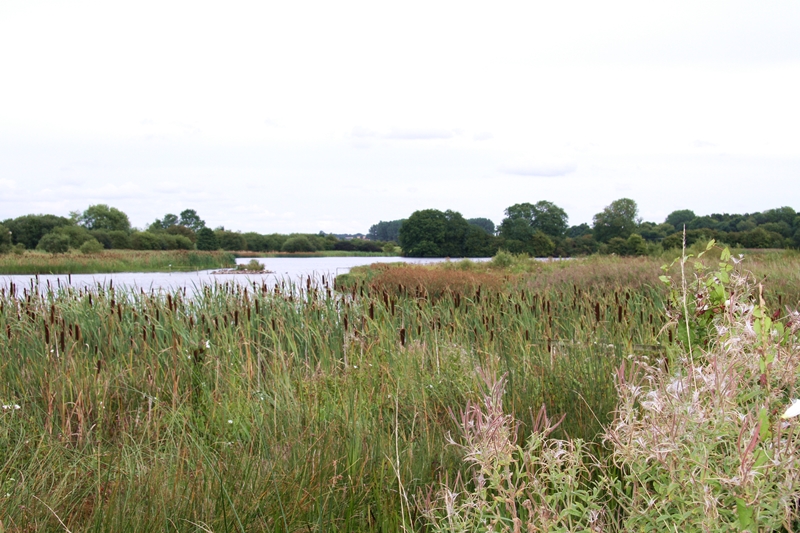
Staveley NR a Yorkshire Wildlife Trust reserve is a superb wetland area, recovered from quarrying that finished in the 1980's and has been managed to offer some rare habitat, and the best thing about it is that it is close to home.  


Over the East lagoon I was greeted by a Hobby being chased by a Black-headed Gull.  There were many Chiffchaff and a small number of Blackcap calling, and a Redpoll flew over calling. Dragonflies were about in small numbers: Common Hawkers, a couple of Brown Hawker, 25+ Common Darters and several Coenagrion sp. which were too far away to see properly.
Common Darter  Sympetrum striolatum
A ladybird seen turned out to be a Harlequin Harmonia axyridis, a species that was first recorded in Britain in 2004 and has spread rapidly north and west.  There are a few extra-limital records further north and in Scotland but Yorkshire is currently at the northern edge of the main range.
Harlequin Ladybird   Harmonia axyridis 
As for butterflies, they were attracted to the blueish globe flowers of Field Scabious in the meadow areas, and included just the one Red Admiral, several Peacock, c.20 Small Tortoiseshell, three Speckled Brown and a Small Copper, while moths were represented by two Udea lutealis and eight Silver Y.
Peacock

Red Admiral

Red Admiral

Red Admiral

Small Copper
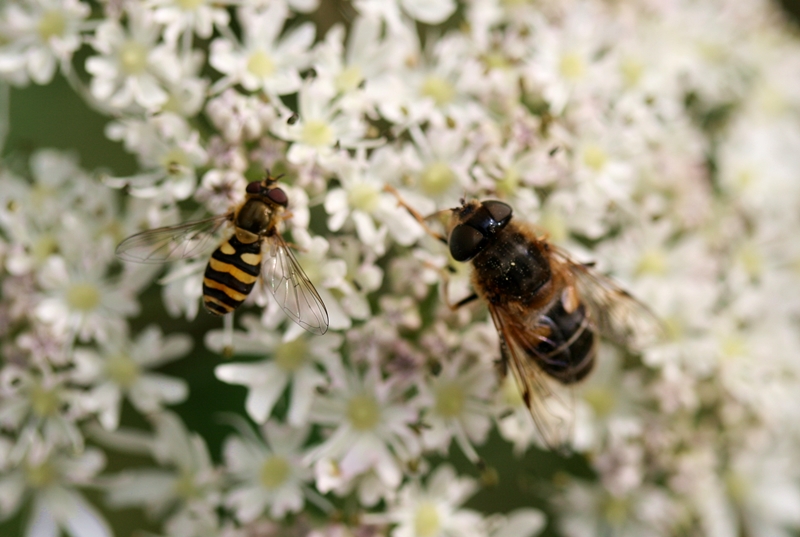
Continuing on from last week I had a go at photographing some of the hoverflies and associated species.  One big black beastie stood out with large size and black bristles on the thorax, which reminded me of the tachinid of last week, and was found to be Tachina grossa, and looking at the state of its wings it was amazing it could fly; a more complete one was seen nearby.
Tachina grossa

Tachina grossa

Tachina grossa
The number and variety of hoverflies was not as good as last week, but those identified are added here.
Helophilus pendulus
Syrphus sp

Eristalis pertinax

Sunday, 2 August 2015

A week in Zante (part three)

Have been back 10 days now and just perusing the photographs again and picking out a few that may be of interest.  The organised boat trip to see the turtles was followed shortly after by hiring a small powered craft which we used to explore Turtle Island and the sea-cliffs around Keri.
Keri harbour
The boat we hired was one of those in the bottom left of the photo above.  The cliffs themselves were dramatic in themselves with the layers evidence of them once being on the sea-bed before the upheaval of being lifted through seismic activity.  The only birds of interest were up to a dozen Pallid Swifts with their distinctive bi-syllabic calls and a single Alpine Swift.


Turtle Island
The open water between the mainland and the islands was actually quite choppy although some of the shots above do show calm water in the lee of the stiff breeze.  Several opportunities to swim in these coves were taken and including a bit of snorkelling by the girls.

On the road to Keri was an outstanding and attractive plant which I eventually photographed at the end of the holiday.  I have seen it in other places in the Med but I took the trouble to look into the identity of the plant on my return.
Century Plant  Agave americana
The taxonomic name suggests the origin of the plant which is in fact from Mexico, but was introduced and has become naturalized in the Mediterranean over the last 200 years.  This flowering stage is very transient, happening only once the plant is 10-15 years old, the stems holding the flowers growing rapidly up to 10m high in a month, and then the plant dies although side shoots may grow on.  In Mexico the national drink 'pulque' is made from the juice extracted from a severed young flower spike and then fermented.  Additionally the dry flower stems make good razor strops! (per Flowers of the Mediterranean by Polunin and Huxley, 1981)
An interesting but as yet unidentified insect
The shed skin of a Cicada
Our villa was home to a small number of Wall Lizards which were always too quick to photograph, and we also had a Common Wall Gecko that lived in the verandah.  Walking around once dark it became obvious that these reptiles were making us of the lights which attracted various insects and provided them with their tea.
Common Wall Gecko  Tarentola mauritanica
A great week, and there can hardly be more of a contrast with the weather back here since our return.