Welcome:

Welcome to my world..............
Showing posts with label Staveley. Show all posts

Saturday, 10 July 2021

National Moth Night 2021

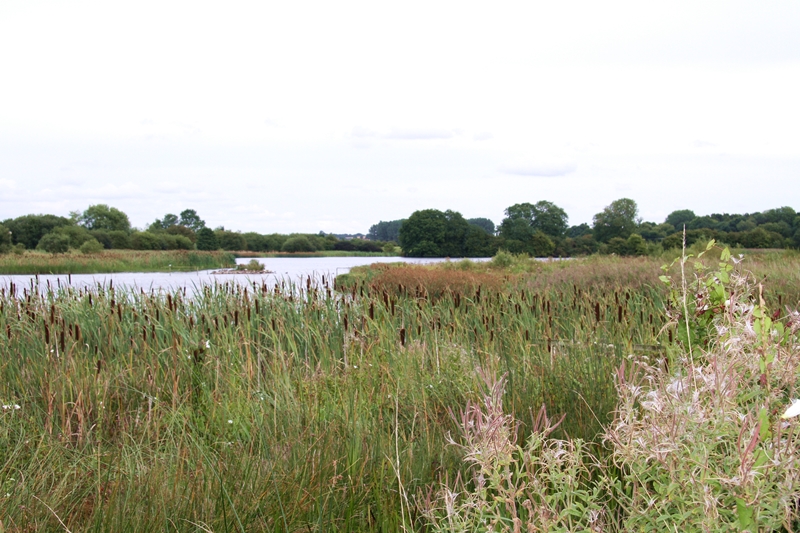
The theme for 2021 is reed-beds and the nearest suitable habitat to me is at Staveley, just a couple of miles from home.  The big drawback for the site is poor access with long distance to lug the equipment to get to the reedbeds.  In the past I have used a wheelbarrow but since my daughter moved her horses away I no longer have that luxury.  On Thursday night 8th July, I managed to get set up based at the furthest hide by 2215, and I retired to the car to get some sleep.  A start at counting and identifying from 0400 and took 3 hours to count the four traps and pack everything away.

A fairly modest haul with no great numbers, and surprisingly few Wainscot species.  A total of about 360 moths of 85 species, several micros still to be sorted, the most numerous being 47 Clouded Border, 40 Smoky Wainscot, 33 Uncertain/Rustic agg., and 26 July Highflier.  The reedbed specialities were few in number but included singles each of  Crescent, Southern Wainscot, and a new Yorkshire record for me of Obscure Wainscot.

73.119 Crescent Helotropha leucostigma

73.294 Southern Wainscot Mythimna straminea

73.302 Obscure Wainscot Leucania obsoleta

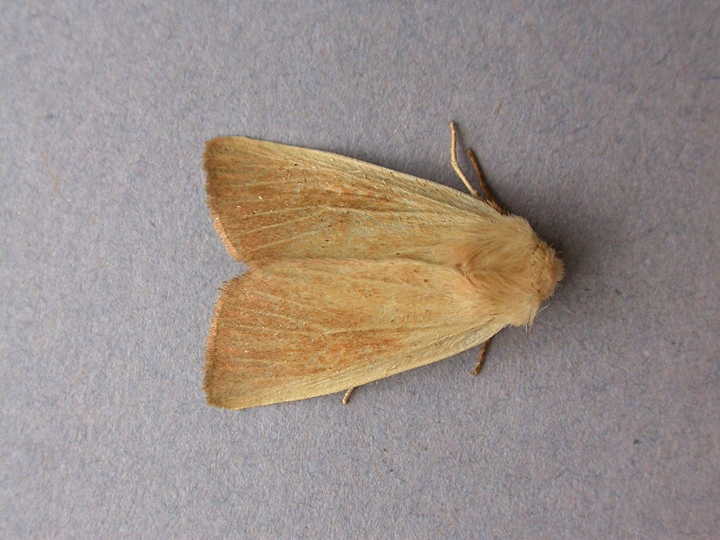
A good feature shown by Southern Wainscot is a browband clearly seen when viewed head-on.

Southern Wainscot, browband feature.

Other species seen included the following, some colourful moths others rather plainer but still of interest. 
49.215 Ancylis achatana

63.020 Anania perlucidalis

63.079 Calamotropha paludella

63.080 Garden Grass-veneer Chrysoteuchia culmella

70.013 Small Fan-footed Wave Idaea biselata

70.093 Barred Straw Gandaritis pyraliata

70.278 Common Wave Cabera exanthemata

73.101 Treble Lines Charanyca trigrammica


Monday, 21 September 2015

Staveley Nature Reserve - Sunday 13 Sep

Staveley NR a Yorkshire Wildlife Trust reserve is a superb wetland area, recovered from quarrying that finished in the 1980's and has been managed to offer some rare habitat, and the best thing about it is that it is close to home.  


Over the East lagoon I was greeted by a Hobby being chased by a Black-headed Gull.  There were many Chiffchaff and a small number of Blackcap calling, and a Redpoll flew over calling. Dragonflies were about in small numbers: Common Hawkers, a couple of Brown Hawker, 25+ Common Darters and several Coenagrion sp. which were too far away to see properly.
Common Darter  Sympetrum striolatum
A ladybird seen turned out to be a Harlequin Harmonia axyridis, a species that was first recorded in Britain in 2004 and has spread rapidly north and west.  There are a few extra-limital records further north and in Scotland but Yorkshire is currently at the northern edge of the main range.
Harlequin Ladybird   Harmonia axyridis 
As for butterflies, they were attracted to the blueish globe flowers of Field Scabious in the meadow areas, and included just the one Red Admiral, several Peacock, c.20 Small Tortoiseshell, three Speckled Brown and a Small Copper, while moths were represented by two Udea lutealis and eight Silver Y.
Peacock

Red Admiral

Red Admiral

Red Admiral

Small Copper
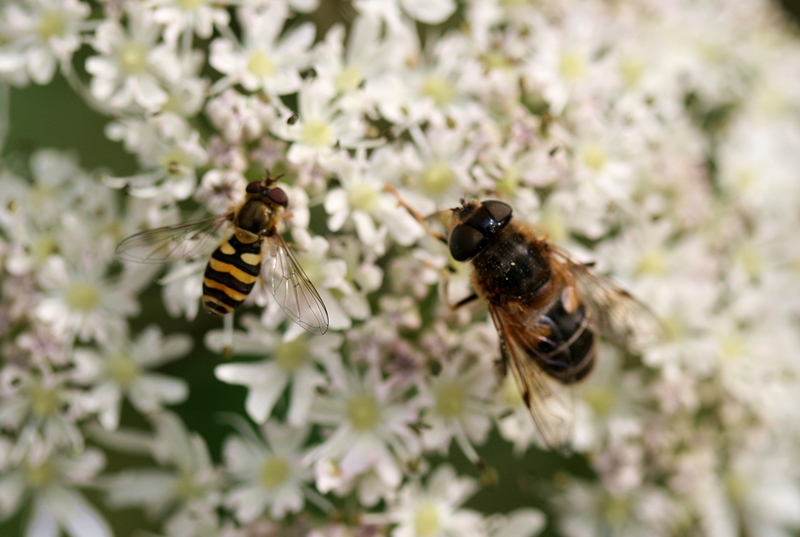
Continuing on from last week I had a go at photographing some of the hoverflies and associated species.  One big black beastie stood out with large size and black bristles on the thorax, which reminded me of the tachinid of last week, and was found to be Tachina grossa, and looking at the state of its wings it was amazing it could fly; a more complete one was seen nearby.
Tachina grossa

Tachina grossa

Tachina grossa
The number and variety of hoverflies was not as good as last week, but those identified are added here.
Helophilus pendulus
Syrphus sp

Eristalis pertinax

Tuesday, 16 July 2013

Three traps in a week!

On the night of Friday 5th July I spent the night at Brimham Rocks in preparation for a Bioblitz planned for the Saturday when various experts were due to be present to try and identify as many species as possible in a 24hour period.  So, I got the ball rolling operating three traps overnight and despite ideal conditions, only managed about 80 species of the usual suspects for Brimham.  The highlight, at least for me, was Ancylis myrtillana, a moorland micro which I had only seen for the first time at this site last year.  Fortunately, for the benefit of the general public who were due to visit during the daytime, I had a good selection of the more colourful moths for their benefit.  These included, Barred Yellow, Peach Blossom, Garden Tiger and Elephant Hawk-moth plus a few of the more regular brown jobbies.  Unfortunately I had to leave for work by 10:00am, but by leaving my potted specimens in a cool place for others to see worked ok.

Trap 2 was at Wellesbourne in Warks at my Brother-in-Law's garden on Wednesday night.  A well-stocked suburban garden adjoining farmland, and the prize was a Cream-bordered Green Pea.  This is a species that somehow never seemed to venture north of Dorchester when I lived in Dorset, and is relatively scarce up here in Yorkshire.  With the Warks County Recorder David Brown only living 3 miles away in Charlecote, I sent him my records as usual, and he commented that he had only had the 2nd and 3rd county records in his garden, so mine was a notable local scarcity.

With this fantastic run of warm weather continuing, Saturday night meant trapping at Staveley NR just 3 miles from where I live.  With three traps around the furthest hide, a double gladiator actinic in the reeds, a Robinson on the main path between the trees and the waterside herbage, and the 160 MVB over a sheet next to the reeds in the more open grassy area.  Despite the early morning mist that bordered on drizzle, there were almost 900 moths of 116 species was the prize, including a new one for me, a Beautiful China-mark.  I had had one before but it escaped before I could pot it and photograph it.
Beautiful China-mark
The highlights among the rest were two Large Clover Case-bearer, six Elachista atricomella, a Metzneria metzneriella, a Syncopacma larseniella/cinctella, a Brachmia blandella, nine Mompha ochraceella, an Endothenia quadrimaculana, three each of Lobesia abscisana and Phlyctaenia perlucidalis, two Adaina microdactyla, three each of White Satin and Double Lobed, 15 Silky Wainscot and two Blackneck.
Large Clover Case-bearer

Metzneria metzneriella

Brachmia blandella

Mompha ochraceela

Lobesia abscisana

Spilonota ocellana

Crambus pascuella

Adaina microdactyla

Green Pug

Shoulder-striped Wainscot

Silky Wainscot.
It is worth bearing in mind that the micro-moths featured here are mostly less than 10mm in length, indeed the plume moth shown microdactyla which is the smallest of the plumes and had a wingspan on less than 20mm. You do not have to be big to be beautiful....

Wednesday, 22 August 2012

A bit if a conundrum.....

Another decent night forecast for Saturday 18th August and traps set at the furthest hide at Staveley.  Not a bad haul in the end with 574 moths of 82 species, with just small numbers of the target reed-bed specialities: 17 Limnaecia phragmitella, one Chilo phragmitella, two Calamatropha paludella, 15 Water Veneer, a Southern Wainscot, three Bulrush Wainscot, one Brown-veined Wainscot and a Fen Wainscot.

So, where's the conundrum?  I caught a Mompha that I was perfectly happy matched one that we had caught there a couple of weeks ago.  However, there were two other white-headed Mompha that defied easy identification.  A trawl of the internet suggested Mompha divisella only recorded once in Yorkshire as a willowherb plant gall, obviously a rare moth but I kept coming back to the same conclusion.   Several opinions from learned colleagues seemed to support my thoughts so I forwarded the details to Harry the County micro-recorder.  While waiting for his reply I checked MBGBI and the illustrations there made me even more confused.
Mompha sp.
Harry came back with the opinion that it was Mompha propinquella, which suggests to me that some of the published photos of divisella may actually be incorrect, and that gen. det. is required to be sure.

A selection of other moths of interest follow.
Ypsolopha scabrella

Epermenia falciformis

Cochylimorpha straminea

Acleris emargana

Fen Wainscot

Monday, 13 August 2012

Got there in the end...

I caught a rather dull grey plume moth at Staveley on Friday night, took two crap photos the following morning before it made a dash for freedom, straight through the gap in the slightly ajar window...   So trying to match the little blighter with various books and web photos, I eventually settled on Oidaematophorus lithodactyla or Dusky Plume as it is called in Sterling and Parsons.  
Oidaematophorus lithodactyla
Fortunately Charlie agrees, him having had one there in 2008, only the second VC64 record.  The wing markings are rather subdued, but can just be made out, and the grey tufts by the spurs on the front two pairs of pale legs a good pointer.

Sunday, 12 August 2012

Reed-bed goodies

I make no apologies for yet another visit to Staveley; it really is a magical place, if hard work.  Having done the woodland end last week, it had to be the reed-bed end this time.  I was rewarded with a new macro, a Butterbur,  a scarce moth nationally, the Yorkshire population of some importance.
Butterbur
In addition, a reasonable selection of reed-dwelling species made the visit worthwhile, with a hat-full of Limnaecia phragmitella, Calamatropha paludella, Southern Wainscot, Bulrush Wainscot, Silky Wainscot and Fen Wainscot.
Slender Pug

Rosy Minor

Brown-veined Wainscot
Lastly, here is a selection of the very variable species Epinotia nisella, some of which had me excited for a while until I realised they were the same species.