Welcome:

Welcome to my world..............

Monday, 23 July 2018

Brafferton Spring, VC62

Brafferton Spring is a private site with lockable access and a part-owner that is keen to establish what wildlife occurs there, especially on his patch.  It is located in VC62 close to Pilmoor and Sessay, This site is an area of old woodland which is thought to have been clear-felled around the time of WW2 as many of the trees are of a similar age.  It is mixed deciduous and conifer trees, with a few small areas opened up to reveal glades and developing under-storey.  It differs from the nearby Pilmoor site in that it does not have any heath or rushy pools, but there is a brook running along the south side of the woodland and man-made pools used for fishing at an adjacent site. 

It is still early days in the moth recording effort and well over 260 species have been identified so far; this should rise significantly when a full year of recording has been achieved.  There have already been a number of good records reflecting the mix of vegetation on site.

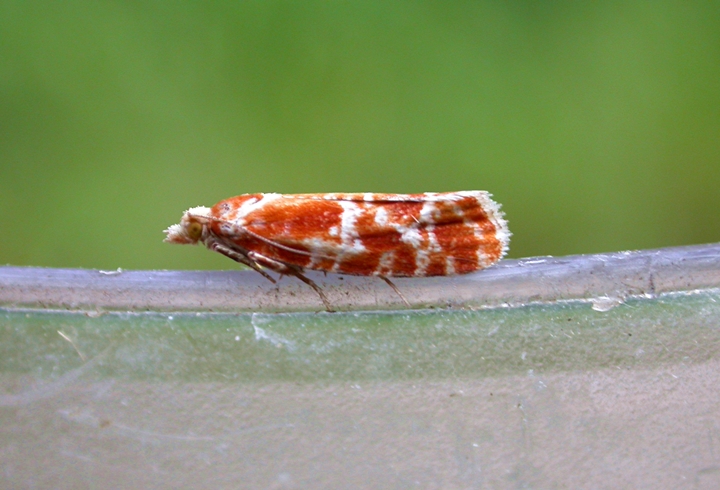
The first photo is of Lathronympha strigana, not especially rare and its patchy distribution may simply reflect recording effort; a subtly beautiful micro-moth with its silver markings on the orange base colour.  
Lathronympha strigana
Tawny-barred Angle moths caught in good numbers here but this is an example of the much scarcer dark form nigrofulvata.
Tawny-barred Angle
This micro-moth was a new one for me and described as rare in the county.  It is only 6mm long and the only representative of its family.
Schreckensteinia festaliella
Since this species returned to the county in 2009 I have had it fairly regularly on the slopes of the North York Moors; this is the first I have had at a lowland site.
Red-necked Footman
The next is very rarely recorded in Yorkshire and this may well be new to VC62.
Epinotia signatana
 This pine-loving and strikingly colourful micro is described as a rare resident in Yorkshire.
Rhyacionia pinicolana
Mere Wainscots are a scarce southern species, but there is a small population in our area being the most northerly in the country;  I have had eight now at three local sites.
Mere Wainscot
This very striking little micro feeds on fungus on hazel and is very rare in Yorkshire.  It may be just the 2nd VC62 record since the first in 1868.
Nemapogon clematella
 The next is a scarce resident in Yorkshire.
Acrobasis consociella
Only first identified in the UK in 2001, and Yorkshire 5 years later, it is still a rarity up here and is likely to be recorded with more regularity.
Dioryctria sylvestrella
A Wax Moth, quite large for a micro, but with this and Lesser Wax Moth recorded here it would indicate the presence of bee hives or wild nests in the area.
Wax Moth
Not my finest selection of photos as some done in poor light on site using my iphone, but needs must...  Looking forward to adding even more exciting moths to the site list.

Saturday, 2 June 2018

Not a bad week....

I normally take this week off each year to accommodate a couple of family birthdays, the weather is usually good, and has also proved excellent for moths. This week has been no exception.  The only downside is that after 13 years of heavy use my generator failed last night, so no records from what would have been the fifth night in a row out trapping.

The trapping events for the week all in VC62 were as follows, including the results and highlights:

26 May - Brafferton Spring, 142 moths of 46 species

28.019 Esperia sulphurella

49.307  Spotted Shoot Moth Rhyacionia pinivorana

71.005  Sallow Kitten Furcula furcula

70.224  Scorched Wing Plagodis dolabraria


28 May - Hood Hill, Kilburn. 566 moths of 81 species

70.151  Foxglove Pug Eupithecia pulchellata

74.009  Oak Nycteoline Nycteola revayana

73.046  Poplar Grey Subacronicta megacephala

73.001  Spectacle Abrostola tripartita


29 May - Brafferton Spring, 228 moths of 58 species

One of the highlights was a Pine Hawk-moth, my first in Yorkshire following a handful seen in Dorset.  Photo taken by phone.
69.007  Pine Hawk-moth Sphinx pinastri

This fantastic micro is only 6mm in length and is one of two very closely related species.  The extent of the yellow almost reaching the cillia at the tip is in favour of C. alchimiella, however, gen.det. would be required to be 100%. 
Caloptilia alchimiella/robustella


30 May - Hood Hill, Kilburn, 454 moths of 66 species


73.016  Beautiful Golden Y Autographa pulchrina
Blomer's Rivulets are pretty scarce nationally and in Yorkshire, but have been regular at the Kilburn sites, and there were ten caught on this occasion.
70.116  Blomer's Rivulet Venusia blomeri


31 May - Pilmoor, 185 moths of 50 species

Rather than the usual trapping on the old railway line I decided to try out on the open heath area, one trap under an oak on the edge of the wood and the Robinson sited in the open next to the rushy pool.  The numbers and variety were initially disappointing but it was soon evident that the quality was exceptional.

One of the few coleophora that can be identified from its markings, and is found in heathery areas.
37.055  Coleophora pyrrhulipennella
The next four are rarities in VC62, and being micros are small in size, the first is only 5-6mm in length and the last is a mere 3mm long.

49.184 Lobesia reliquana

49.298  Notocelia trimaculana

49.240 Epinotia immundana

08.005  Phylloporia bistrigella
A fantastic few days trapping culminating in my trusty generator conking out last night and also knocking over the tripod while setting up and breaking one of my bulbs...

Sunday, 13 May 2018

Other species this week

As a consequence of actually spending a bit of time out during the day in my local birch woods, it is inevitable that other species were noted and here is a selection of what was seen.
Adela reaumurella, female, Sessay Wood

Adela reaumurella, males, Sessay Wood

14-spot Ladybird, Pilmoor Hall

Yellow-tail Moth, larvae, Pilmoor Hall

Common Leaf Weevil, Sessay Wood

Large Emerald, larva, Pilmoor Hall

Green Shield-bug,  mating pair, Sessay Wood

Orange-tip, Sessay Wood

Red and Black Froghopper, Sessay Wood

Tipula paludosa, Brafferton Spring
Abia candens, a saw-fly, Brafferton Spring

Dark-edged Bee-fly, Brafferton Spring

Four-spotted Chaser, Pilmoor

Birch leaf-miners

Following on from the frustrating fact that none of the purple-coloured Eriocranias I have caught at Pilmoor could be identified with any certainty without dissection, and my two old records of probable salopiella mines in very early June 2012 and 2015 were very likely but not accepted, I have put some effort into looking at birch leaf-mines this year.  Five visits to different but closely related sites at Pilmoor, Sessay and Brafferton have certainly produced the goods!

From my previous records of adults all entered into MapMate as semipurpurella (mainly due to the fact that there is no option to record eriocrania sp., and was considered to be the most common), the results of this week cannot be more different.  Of course from just 7 days data this may be slightly distorted in that semipurpurella may have a slightly earlier/later larval stage and its actual presence masked. It is also noticeable the number of wilted empty mines that have increased over the week making them unidentifiable.  Nevertheless, the most common species found this week is Eriocrania sangii, with smaller numbers of unimaculella and cicatricella and my main prize of an early instar of salopiella (identified and confirmed by Ben Smart), and two further salopiella today.  A small number of possible semipurpurella larvae could not be confirmed with any certainty.  All of these listed below are new for me and all are under-recorded in Yorkshire, making all of these significant records, especially the salopiella.

2.003 BF8 Eriocrania unimaculella


Dark brown head capsule with two dark dots immediately behind.


2.005 BF10 Eriocrania salopiella


The leaf-mine begins as a narrow gallery in the centre of the leaf, turning into an elongate blotch and then a larger blotch encompassing the leaf margin.  Spurred on by this success, two more were found at Pilmoor Hall and Sessay Wood this morning.


2.006 BF11 Eriocrania cicatricella


Often between 2 and 4 larvae in a mine, the larvae having swollen couple of segments immediately behind the head.


2.008 BF12 Eriocrania sangii


The easiest to identify in that the larvae are dark grey.

I just need sparrmanella next month and it will be almost a complete set!


Monday, 23 April 2018

Spring has sprung


The fabulous weather of the last week puts a completely different complexion on everything.  Singing Willow Warblers, Blackcaps have joined the Chiffchaffs that have been here a couple of weeks, Sand Martins on the River Ure and Swallows in small numbers.

Three weeks into April and two more new moths: the first was a tiny micro attracted to my living-room TV screen on 10th March.  I potted it and had great difficulty in getting it calm enough to photograph but eventually got a couple of record shots; obviously a Mompha and looked a ringer for bradleyi and has been accepted as such by Harry the micro CMR.  Only first recorded (or at least identified) in the UK in the early 1990's and rare in Yorkshire.
Mompha bradleyi
The second new moth was a very rare resident only found in a small number of coastal sites in North Wales, Lancashire and the extreme west of Scotland.  Following a visit to my daughter I visited a known site near Heysham on 14th April and spent a brief search of the salt-marsh.  I was lucky enough to find a fine male, the females are wingless.
Belted Beauty
A couple of dry and not too cold weekend nights in April tempted me out trapping at Pilmoor, VC62,  with reasonable success for spring moths: 284 of 20 species on 6th and 246 of 19 species on 14th, the highlights being two each of Semioscopis avellanella and Red Sword-grass.

Red Chestnut

Red Sword-grass
Brindled Pugs

Brindled Pugs

Clouded Drab

Twin-spotted Quaker

Water Carpet f.piceata
The last is a micro likely to be either Eriocrania sangii or semipurpurella, and would need genitalia examined to be sure.
Eriocrania sp.