The 2nd-winter Iceland seen in flight twice today at Allerton, and my visit interrupted by a conversation with one of the contractors.....the pools ARE due to be filled in, progress stalled by the recent weather. What a shame, and a wasted opportunity.
Friday, 8 February 2013


Wednesday, 6 February 2013
Allerton Tip Iceland Gull
The one advantage of these very breezy days is that the gulls at Allerton will at least be all pointing in the same direction! This helps in looking at and assessing shades of grey and any darker (or paler) backed gulls stand out that much better. With the winds from the north today, most of the gulls were actually rear-on, rather than the usual side-on. No repeat of the 2nd-winter Iceland from last Friday, and the gulls were very flighty, being put up by a couple of Red Kites which looked fantastic in the low bright sunlight highlighting every hint of colour in the birds. It soon became obvious that many of the gulls were actually in the dip the other side of the bank. I drove round to look from the farm road parallel to the old A1, and waited for the gulls to fly up. With the sun now right behind me and the distant sky dark grey and dropping curtains of snow, when the gulls flew up they really stood out against the background. Sure enough, the 2nd-winter Iceland Gull was soon picked out among the hundreds of Herring Gulls, and it lazily flew off to the north.
So, the threat of the first washing pit to be filled in may have passed, indeed the earth-moving equipment seem to have excavated another deeper pool just to the north of the main pit. Perhaps my unacknowledged correspondence with the land-fill company actually worked - who knows.....
Sunday, 20 January 2013
Colour-ringed Godwits
Back in September I posted on my visit to south-west Ireland and added some photos on a couple of first-year colour-ringed Black-tailed Godwits at Roscarberry, Co Cork. They were part of a flock of c.500 birds, mainly first-years, and the two colour-ringed birds were observed in close proximity for several hours on 19th September. The rings are as follows:
Bird 1 on left: Left leg - pale green over dark green Right leg - red over yellow flagBird 2 on right: Left leg - dark green over black Right leg - yellow over yellow flag
 |
| Black-tailed Godwits |
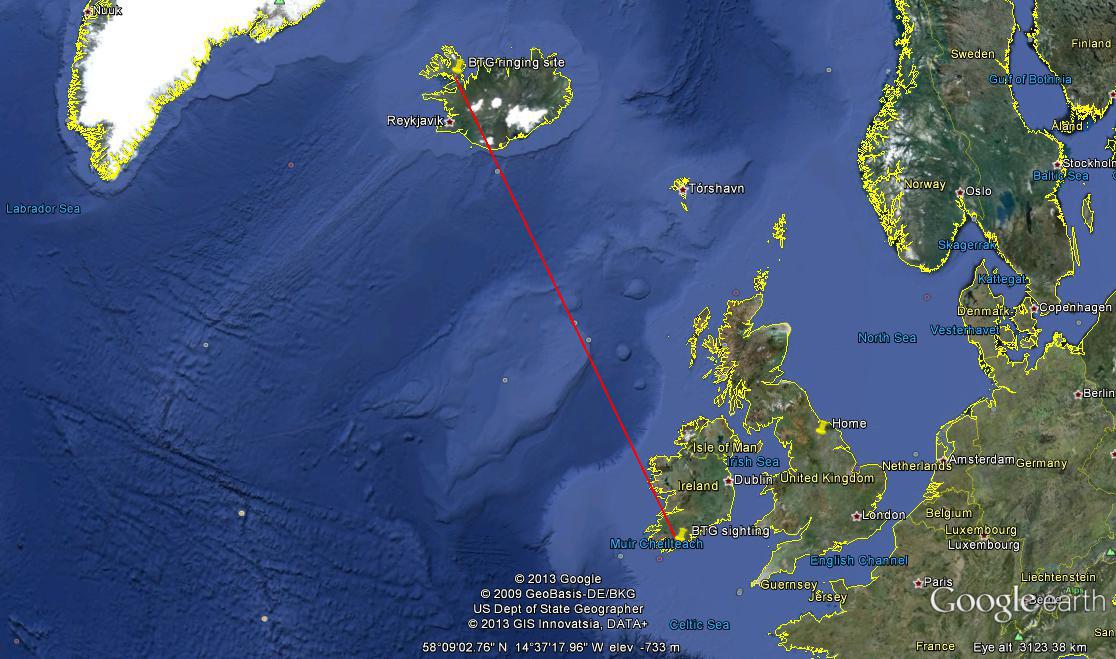
I scoured the internet and found several addresses for people who carried out Black-tailed Godwit ringing and sent off the details. Not having heard anything I rather gave up hope, but out of the blue I received an email this morning from a Peter Potts with details on the birds. Both birds, as suspected, were Icelandic, having been ringed there earlier in the year. Their ringing details are as follows:
Bird 1 on left: ringed in the southern lowlands of Iceland - details to follow.
Bird 2 on right: ringed on 1st July 2012 at Klettur, road 60 north of Kroksfjardarnes in NW Iceland at 65 28 976'N 21 56.631'W.
 |
| Ringing site, photo P Potts |
 |
| Ysbrand Galama and Dan Hoare, photo P Potts |
 |
| Bird 2 in the hand, photo P Potts |
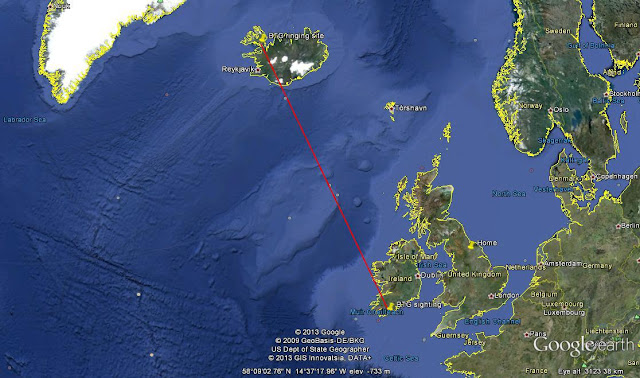 |
| 1700km from ringing site to where I saw it in Ireland |
Monday, 31 December 2012
2012 and all that...
Far too long since the last post, although to be fair I have been rather unwell for five weeks and just not had the energy or inclination to do anything demanding on the computer let alone go out and do some natural history watching!
So, 2012, a year of ups and downs at best, and continues the run of cloudy and often unsettled weather of the last six years, due to the more southerly path of the jetstream. Presumably as a direct result of the shrinking polar icecaps and unlikely to reverse anytime soon, and rather depressingly a portender of summers to come.
On the ornithological front, probably the worst in 40 years of active birdwatching. Other than the occasional visit to Nosterfield, watching the gulls at Allerton and a brief few days in Ireland, the impetus to get out and about has been further dulled by the modern birding scene and obsession with rarities, and opinionated mediocrity. The few highlights were the decent run of white-winged gulls in the spring, fantastic regular views of Red Kite, dawn-choruses of waking marshland birds at Staveley, some decent seabirds and wonderful Choughs on the Irish west coast and the only BB rarity of the year, a Semi-P on a beach in Ireland. Hardly a vintage year.
 |
| Red Kite |
| 481 | Epermenia falciformis | 1st VC62 |
| 849 | Syncopacma cinctella | 2nd VC64 and 3rd Yorkshire |
| 854 | Anacampsis blattariella | 5th VC62 |
| 878 | Batrachedra praeangusta | 5th VC62 |
| 930 | Gynnidomorpha alismana | 1st VC64 and 6th Yorkshire |
| 968 | Cochylis nana | 3rd and 4th VC62 |
| 1086 | Hedya salisella | 4th and 5th VC62 (the 3rd was mine too) |
| 1089 | Apotomis semifasciana | 4th to 8th VC62 (all the others are mine) |
| 1104 | Endothenia quadrimaculana | 5th to 8th VC64 |
| 1106 | Lobesia reliquana | 1st and 2nd VC62 and 7/8th Yorkshire |
| 1123 | Ancylis laetana | 3rd to 7th VC62 (all of which are mine, one other site in Yorkshire) |
| 1132 | Epinotia subocellana | 2nd VC62 |
| 1135 | Epinotia demarniana | 6th to 12th VC62 (all VC62 records mine from 1 area and confirmed) |
| 1137 | Epinotia tetraquetrana | 3rd VC62 and 4th VC64 |
| 1217 | Eucocosmomorpha albersana | 2nd Yorkshire record since 1987, the 1st was mine in 2011, a handful of older records |
| 1225 | Pammene obscurana | 2nd VC62 and 5th Yorkshire (I had 1st VC62 too) |
| 1348 | Parapoynx stratiotata | 2nd VC64 |
| 1473 | Ephestia elutella | 1st VC65 and 12th Yorkshire |
| 1517 | Adaina microdactyla | 5th VC64 |
| 1523 | Oidaematophorus lithodactyla | 3rd VC64 |
Once all of the 2012 records are included and published in the Yorkshire database some of these figures may have to be updated, but it is certainly an indication of the quality of the years trapping.
My moth of the year? Well, it has to be this one, a Bordered Pug at Staveley, not particularly rare but a stunning pug all the same. This was followed very closely by the remarkable sight of six Lunar Thorns together at Brimham, my only previous ones being a single at Brimham and one in my Dorset garden.
 |
| Bordered Pug |
What for 2013? Other than the pressing requirement to achieve a more stable economic base for the family, I look forward to concentrating my efforts locally again, with perhaps also some selective effort on the southern fringes of the NY Moors, and looking at other orders to broaden my interests.
Saturday, 3 November 2012
Bugs ... and everything
Too cold at night to tempt me out trapping but a very pleasant afternoon on Thursday 1st and a brief excursion to Pilmoor. I suppose I have developed a further interest in the site after preparing a report for Natural England who manage part of the site as a SSSI. As I was short on time I concentrated checking the beech trees at the SE corner looking for leafmines; on the same date in 2009 I had seen a few mines of Stigmella tityrella and I wanted to repeat this and also to look for the other beech miner Stigmella hemargyrella. Despite a thorough search of the beech I could not find any mines at all. However I did find a shieldbug at rest on a sycamore which I photographed.
 |
| Hawthorn Shieldbug |
Having got home and looked up the literature and web resources ( http://www.britishbugs.org.uk/index.html a superb site!) the bug was identified as Hawthorn Shieldbug Acanthosoma haemorrhoidella.
Buoyed by identifying such a good-looking insect I trawled through my photos and located another three shieldbug species all for Pilmoor: Birch Shieldbug, Red-legged Shieldbug and Common Green Shieldbug, all of which are reasonably common. It did set me thinking especially after visiting Mark Telfer's site (superb for beetles) where there was a section on pan-listing. I did a quick tot up of the species in which I was interested and was surprised to come up with a total list of c.1700 species. With about 73% of this made up with moths and birds with many fewer (now that's an oxymoron...) vascular plants, butterflies, mammals, fish etc., there seems to be plenty of scope for bumping the list up...if I could be really bothered ;-)
Tuesday, 23 October 2012
A new one for Pilmoor
Having not done any trapping for weeks now, probably mainly due to the lack of mild, calm and dry nights, along with a general malaise that sets in as moth numbers plummet, Saturday 20th Oct looked a good night to do some trapping. Pilmoor was the easiest and closest site to home and four hours in perfect conditions produced 46 moths of 12 species. The highlight, although not realised at the time, was a December moth, which was new for site. Amazingly I have only had one other record, and as its name implies is a late flier, and obviously under-recorded due lack of trapping effort in late autumn.
1044x Acleris ferrugana/notana 1
1048 Garden Rose Tortrix (Acleris variegana) 2
1062 Acleris emargana 1
1631 December Moth (Poecilocampa populi) 1
1769 Spruce Carpet (Thera britannica) 1
1795x November Moth agg. (Epirrita dilutata agg.) 27
1923 Feathered Thorn (Colotois pennaria) 8
2126 Setaceous Hebrew Character (Xestia c-nigrum) 1
2247 Merveille du Jour (Dichonia aprilina) 1
2258 Chestnut (Conistra vaccinii) 1
2263 Red-line Quaker (Agrochola lota) 1
2477 Snout (Hypena proboscidalis) 1
 |
| Acleris emargana |
Friday, 12 October 2012
Noah can rest easy now....
Now ten days or so since the floods here in Langthorpe it was time for some photos of what the river should look like. Not entirely true as there was torrential rain last night and the rather muddy water is about 50cm above normal levels; this is still 5.5 metres lower than last weeks record level. The following pic shows some Giant Hogweed suspended in the willow to the left, which gives an indication of the flood level.


Here is a photo of our building, then a brewery for Mustill Brothers, and looking at the vehicles it must be around the 1920's.
Subscribe to:
Posts (Atom)