Welcome:

Welcome to my world..............
Showing posts with label Ireland. Show all posts

Sunday, 20 January 2013

Colour-ringed Godwits

Back in September I posted on my visit to south-west Ireland and added some photos on a couple of first-year colour-ringed Black-tailed Godwits at Roscarberry, Co Cork.  They were part of a flock of c.500 birds, mainly first-years, and the two colour-ringed birds were observed in close proximity for several hours on 19th September.  The rings are as follows:

Bird 1 on left:  Left leg - pale green over dark green    Right leg - red over yellow flag
Bird 2 on right:  Left leg - dark green over black    Right leg - yellow over yellow flag

Black-tailed Godwits
I scoured the internet and found several addresses for people who carried out Black-tailed Godwit ringing and sent off the details.  Not having heard anything I rather gave up hope, but out of the blue I received an email this morning from a Peter Potts with details on the birds.  Both birds, as suspected, were Icelandic, having been ringed there earlier in the year.  Their ringing details are as follows:

Bird 1 on left:  ringed in the southern lowlands of Iceland - details to follow.
Bird 2 on right:  ringed on 1st July 2012 at Klettur, road 60 north of Kroksfjardarnes in NW Iceland at 65 28 976'N 21 56.631'W.
Ringing site, photo P Potts
Ysbrand Galama and Dan Hoare, photo P Potts

Bird 2 in the hand, photo P Potts
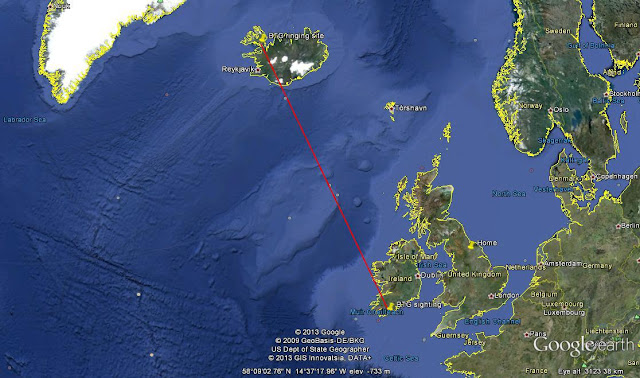
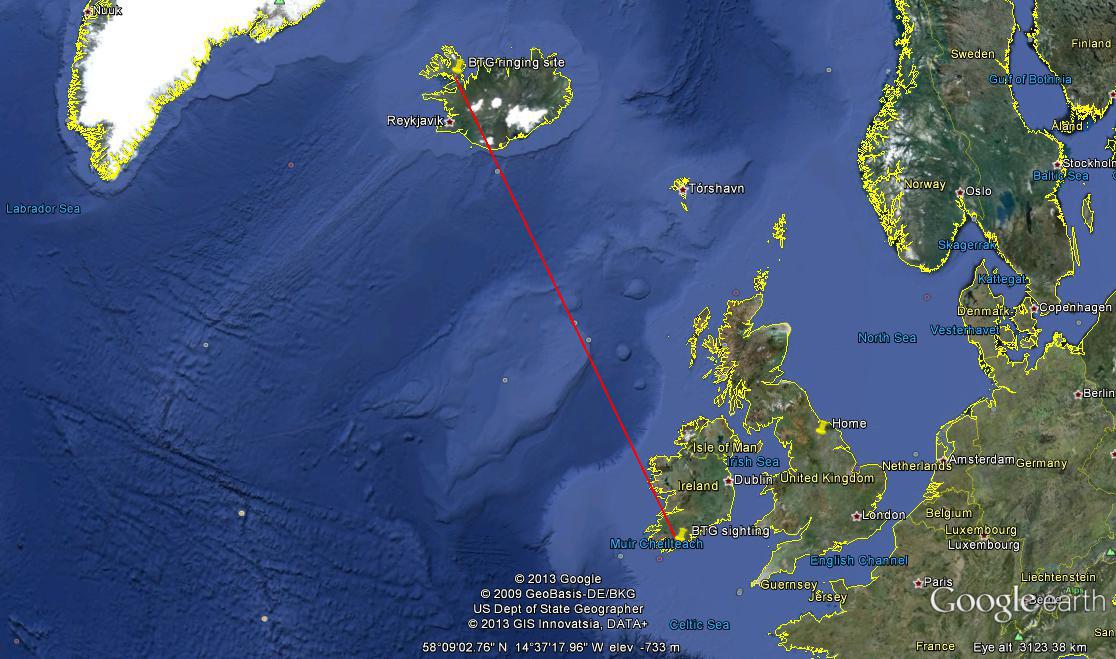
1700km from ringing site to where I saw it in Ireland


Monday, 31 December 2012

2012 and all that...

Far too long since the last post, although to be fair I have been rather unwell for five weeks and just not had the energy or inclination to do anything demanding on the computer let alone go out and do some natural history watching!

So, 2012, a year of ups and downs at best, and continues the run of cloudy and often unsettled weather of the last six years, due to the more southerly path of the jetstream.  Presumably as a direct result of the shrinking polar icecaps and unlikely to reverse anytime soon, and rather depressingly a portender of summers to come.

On the ornithological front, probably the worst in 40 years of active birdwatching.  Other than the occasional visit to Nosterfield, watching the gulls at Allerton and a brief few days in Ireland, the impetus to get out and about has been further dulled by the modern birding scene and obsession with rarities, and opinionated mediocrity.  The few highlights were the decent run of white-winged gulls in the spring, fantastic regular views of Red Kite, dawn-choruses of waking marshland birds at Staveley, some decent seabirds and wonderful Choughs on the Irish west coast and the only BB rarity of the year, a Semi-P on a beach in Ireland.  Hardly a vintage year.
Red Kite
A productive year on the moth front with just under 10,000 identified of at least 435 species, despite coverage during the year being very patchy.  No trapping was attempted during the very wet April into mid May, mid August to early September, and thereafter were just single visits to Pilmoor in mid-October and November.  The range of sites was much more restricted this year, concentrating effort on the sites closer to home, mainly Pilmoor and Sessay area and Staveley; there were no visits to my usual sites on the North Yorkshire moors or visiting under-recorded 10km squares around the county.  With 36 nights out against 45 in 2011, the reduced number of sites and the gaps in coverage, makes the totals achieved rather more respectable.  There were five macro-moths which were new to me, and about 35 new micros, their identification assisted greatly with the new book by Sterling and Parsons, and the status and distribution of moths in the county made available for the first time on the Yorkshire Moths website. Referring to the website, which currently is up-to-date to end of 2011, I have tentatively applied some figures to my rarer catches.

481 Epermenia falciformis 1st VC62
849 Syncopacma cinctella 2nd VC64 and 3rd Yorkshire
854  Anacampsis blattariella 5th VC62
878  Batrachedra praeangusta 5th VC62
930  Gynnidomorpha alismana 1st VC64 and 6th Yorkshire
968  Cochylis nana 3rd and 4th VC62
1086  Hedya salisella 4th and 5th VC62 (the 3rd was mine too)
1089  Apotomis semifasciana 4th to 8th VC62 (all the others are mine)
1104  Endothenia quadrimaculana 5th to 8th VC64
1106  Lobesia reliquana 1st and 2nd VC62 and 7/8th Yorkshire
1123 Ancylis laetana 3rd to 7th VC62 (all of which are mine, one other site in Yorkshire)
1132  Epinotia subocellana 2nd VC62
1135  Epinotia demarniana 6th to 12th VC62 (all VC62 records mine from 1 area and confirmed)
1137  Epinotia tetraquetrana 3rd VC62 and 4th VC64
1217  Eucocosmomorpha albersana 2nd Yorkshire record since 1987, the 1st was mine in 2011, a handful
of older records
1225  Pammene obscurana 2nd VC62 and 5th Yorkshire (I had 1st VC62 too)
1348  Parapoynx stratiotata 2nd VC64
1473  Ephestia elutella 1st VC65 and 12th Yorkshire
1517  Adaina microdactyla 5th VC64
1523  Oidaematophorus lithodactyla 3rd VC64

Once all of the 2012 records are included and published in the Yorkshire database some of these figures may have to be updated, but it is certainly an indication of the quality of the years trapping.

My moth of the year?  Well, it has to be this one, a Bordered Pug at Staveley, not particularly rare but a stunning pug all the same.  This was followed very closely by the remarkable sight of six Lunar Thorns together at Brimham, my only previous ones being a single at Brimham and one in my Dorset garden.

Bordered Pug
What for 2013?  Other than the pressing requirement to achieve a more stable economic base for the family, I look forward to concentrating my efforts locally again, with perhaps also some selective effort on the southern fringes of the NY Moors, and looking at other orders to broaden my interests.

Wednesday, 26 September 2012

A week in Ireland

Having found an exceptionally cheap way of getting to Ireland (just £67 plus £4 booking fee Return to get from Leeds Bus Station all the way to Limerick) I just had to give it a go.  When you consider the foot-passenger fare on the ferry from Holyhead to Dublin is £28 each way this is amazing value.  The only downside was that it was by coach, as fairly comfortable as it was, the spending of 17 hours travelling overnight brought back dark memories of two months on Greyhound buses and three days on a coach from Athens to London all those years ago....

So having got all the way to Limerick, and 45 minutes on a local bus got me to Shannon Airport where a pre-booked hire-car awaited, I was on my way.  Another hour or so later I was happily tucked in with four other birders at the Bridges of Ross on Loop Head looking at seabirds in a good stiff westerly gale.  To be greeted with 'You should have been here this morning...' was not what I wanted to hear, and the passage up to 1100 had included over two hundred Sooty Shearwaters and several Long-tailed Skuas.  After a quiet start, the late afternoon haul did produce at least six Sooties, 12 Bonxies, an Arctic Skua, two close adult Sabine's Gulls, and c.25 Grey Phalaropes.  Several hours sat on a rock after sitting for so long on a bus was hard to take, so with movement tailing off I had a look for an American Golden Plover that had been seen irregularly, to no avail.

The next morning the wind had moved round to the north, the spray was bad and very few birds, so decided to drive round the Ring of Kerry (oooer Matron!) with fantastic scenery and occasional stops at sandy beaches looking for waders.  Looking for Reenroe beach at Ballingskelligs which had hosted several yank waders over previous days, a place not on any of my maps and apparently unknown to the odd locals I spoke to.  As it turns out I did find the actual beach, but the state of the tide and bloody fisherman meant that the only waders on the beach were on a fisherman....

Ballinskelligs
Ballinskelligs


The next day was spent at Rosscarbery on the south Cork coast, a wonderful sandy estuary surrounded by minor roads giving full uninterrupted views, and with plenty of waders just screaming out for a yank wader hiding amongst them.  I spent the whole day there scanning every nook of the estuary and looking carefully at all the waders but could not squeeze any rarities out.

Rosscarbery

Roscarberry

However, great views were had of up to 18 Little Egrets, c.500 Black-tailed Godwit, 17 Greenshank and a sprinkling of Sanderling and Knot among the Dunlin and Ringed Plovers.  At least three adult and a first-winter Mediterranean Gull were seen among the gulls.

Black-headed Gull

Little Egret


Greenshank

The Black-tailed Godwits were in all manner of plumages from almost full summer plumage through to moulting juveniles, and presumably most if not all were Icelandic birds en route to wintering quarters.

Black-tailed Godwit


The next image has an interesting example of rhynchokinesis on the left-hand bird, the elasticity of the upper mandible tip which allows grasping and manipulation of prey without opening the bill.


Of interest among the Black-tailed Godwits were a couple of colour-ringed individuals, the details of which I have sent off to the Icelandic authorities for further information.

colour-ringed Black-tailed Godwits

Overnight at Rosscarbery, gave me another chance to look for waders the next morning.  In fact many of the smaller waders seem to have moved out, the only notable addition was a 1st-year Little Gull.  So, a drive east to the nearby Inchidonny and Clonakilty estuaries again looking for waders and a possible Azorean Yellow-legged Gull.  They are odd estuaries in that from being totally full, it seems like it takes only minutes for all of the water to drain into the waterways, so flood to desert in a blink of the eye.  Waders were much fewer in number and it was the muddy pools at the north end by the embankment that were best, with several hundred Black-tailed Godwit, a half-hidden Knot that had me going for a while and a Green Sandpiper.  Parking here is extremely difficult here and you take your life in your hands birding on the narrow roads....and then the rain came.  Views of the gull flocks bearer the estuary moth and especially off the Ring gave up a couple of first-year Mediterranean Gulls and a sleeping Yellow-headed Gull displaying some heavy streaking around its head, but not quite as much as I was expecting as the crown was much clearer of streaking.  A close Guillemot off the Ring on the incoming tide gave reasonable passing views.

Guillemot
A evening drive and beach-side overnight stop next to Garretstown beach near Kinsale, and I awoke to a beach totally devoid of any waders at all.  On cursing my luck on managing to avoid all the yank waders, I drove on a couple of hundred metres and found the real beach.  This was more like it.  Dozens of Turnstone, Ringed Plover, Dunlin and Sanderling spread the length of the seaweed strandline with the sun behind me...and sure enough I found the first-year Semi-palmated Sandpiper.  What cracking views of a stunning bird, no problems in identification, and plenty of video footage taken.  When I decided to try and photograph it, the pesky dog-walkers arrived and ensured that every bird took to flight, completely oblivious to the disturbance they were concerning despite my animated attempts to wave them away....bah humbug!

The afternoon further east in Co Wexford at the estuary south of Wellingtonbridge produced yet more Black-tailed Godwit,  including two more colour-ringed birds; unfortunately they were both sleeping with one leg tucked up so could not get the full colour combination.

I spent the night with my Mother and family near Duncormick, close to a village which appears on the maps but impossible to locate in real life...Bastardstown.  It would have appealed to my Dad to have had that in his address...  So Saturday was a visit to Tacumshin, a superb place, but host to about a dozen dudes displaying absolutely no field-craft and walking right out to the muddy margins and wondering why all the waders were flying off.  Having been denied a pleasant spot of wader watching at one of Ireland's premier sites by thoughtless birders who should know better rather than thick dog-walkers, a visit to the nearby Lady's Island rounded off by some goujons of cod from the world's best fish and chip shop at Kilmore Quay was divine.

Saltee Chipper

Turn round from the Saltee Chipper and the boats that brought the fish in are tied up in the small harbour.  I do not know how you would measure the carbon foot print of walking across the road with a box of fish...

Kilmore Quay
A Sunday evening drive to Tipperary and on to Limerick on Monday morning where rather disappointingly the locals did not talk in rhyme...  Hire-car dropped off at a very rainy Shannon departing in the same weather as I arrived, a local bus back to Limerick before the coach trip overnight back to Leeds and yet another local bus to Harrogate where I picked up Em's car to get home.

Epic travelling, a numb bum, some great scenery, super birds, a superb meal at The Yard in Wexford with Mother and family and those unbelievably good cod goujons all made for a great experience.


Saturday, 3 September 2011

I've got one Ear.....

....and yes Andy before you say anything it is a Large one.  Having caught an Ear agg. in south-west Ireland, I collected the specimen to bring back home for the Yorkshire county moth Recorder to do a gen.det. (genitalia dissection) on it.  Charlie had requested Yorkshire specimens to be sent to him to get a better idea of which Ear species are here in the county - Yorkshire has all four British species.  So, after 10 minutes preparation the genitalia were exposed to show a male Large Ear; a new site record according to the Moths of Ireland.  A couple of other specimens sent through the post turned out to be another Large Ear, and the other a male Crinan Ear.  I attach a photo of the live moth out of interest.
Large Ear

Saturday, 27 August 2011

What a cracking place...to be sure

I have just returned from a great week away visiting parts of south-west Ireland, names of places I have heard of but could not pin down on a map, and those that conjure up visions of hordes of seabirds battling by rocky headlands.  Day One was the long drive from Yorkshire to Holyhead, highspeed ferry to Dublin (actually quite good for seabirds), and then a drive to the west-coast on the Dingle peninsula.


Heading south through the amazing Killarny National Park, heading for Mizen Head in the extreme south-west, in the hope of getting some seabird passage in the stiff breeze.  Of course on arrival, the wind eased, and rain dampened an attempt at moth-trapping in the nearby reed-bed, with only two moths trapped.  All day sea-watching off Mizen Head brought thousands of Manx, Gannets, Kittiwakes, the odd Arctic Skua but no large shearwaters.  Still a great place, with Choughs calling and flying around the whole time.  The nearby beach and shallow reedy pool was good for waders, and I could just imagine the number of yank waders that must have made first land-fall here...but not today.
Chough, Mizen Head
 

The next night was spent trapping at the head of a small rocky ravine surrounded by moorland at Oughtminnee on the north side of Mizen, and a successful night with some interesting moths.  A couple of featureless grey 'things' defying identification, now turn out to be Sweet Gale Moth, a goody no less.

Dark Spectacle


Sweet Gale Moth

Scarce Footman

Straw Underwing
A leisurely drive to Rosscarbery, where the fantastic estuary could easily be seen from the road, and loads of waders were scrutinised for rarities, but even the numerous common ones were a pleasure.  That night, I trapped on the sand-dunes at Castlefreke Warren, and added While-line Dart to the trip list.
White-line Dart
The renowned Ballycotton was signposted off the main drag east, and a pleasant walk around the area produced hundreds of adult Six-spot Burnets, with at least a thousand larval cases among the rough grass.
Six-spot Burnet

Following the coast road to the east, I ended up at a place called Fennor Bog south of Waterford, and although it started off as a calm and clear night, I was woken up just before midnight by rain spotting on the window, and by the time I got out to the traps, it was thrashing down, and I managed to get a cover on the Robinson trap, but not quick enough to save the bulb from blowing on the one suspended over the sheet.  I left the MV running, despite the rain, and ended up with a reasonable haul the next morning.
Haworth's Minor

Round-winged Muslin 
 Next morning a pleasant drive east again, over the ferry to Ballyhack, and down to Hook Head, and then up the coast to Wellingtonbridge.

Monday, 4 April 2011

500 miles, two lifer's, the best fish and chips in the world....oh, and visit Mum on Mothering Sunday

This flying visit to Ireland had been booked for some weeks, so was relieved to hear that the Stejneger's Scoter was still hanging around at Rossbeigh.  Arrived Cork Friday evening, and spent an hour or so at Cobh, missing the Indian House Crow for the second time.  I then drove to Killarney for something to eat, and then on to Rossbeigh for the night.  Heavy rain and strong winds overnight, but awoke to some blue sky with odd showery clouds scuding by.  A sweep of the bay saw at least 500 Common Scoter in scattered groups, seven Great Northern Divers and an Eider.  Three other birders walked down the lane, so I walked up the lane, and sure enough soon picked out the target bird at several hundred metres range among 200 or so Common Scoter.  It was suprisingly easy to pick out, with the white flash behind the eye and the white secondary panel, but if any further out would have been a real challenge.  I called the other birders over, casually asking where they had come from....and yes it was bloody Yorkshire.  What a fabulous vista of the choppy sea, especially as the sun came up casting shadows, loads of Gannets wheeling about, and several Chough calling from the hillside.

Rossbeigh
It then took 4.5 hours to drive across country to Wexford to stay the night at Mums, where we paid a brief visit to Kilmore Quay.  I had my first Sandwich Terns of the year fishing off the quay, summer plumaged Razorbill, and close views of a Guillemot, which unfortunately was oiled on its breast.
Guillemot, Kilmore Quay
 On Sunday, had a brief visit to Ladys Island, where there were small numbers of wildfowl, but of interest were at least 40 Mediterranean Gulls, mainly summer-plumaged adults, a single 2nd summer, and at least two first-winters.  The rather effeminate 'oooeer' call from some of the Meds was very distinctive, if not rather amusing.  Not much to report from nearby Tacumshin due disturbance from several birdwatchers walking about, but was more than compensated for by some battered cod goujons and home-made tartare sauce from the best chippy in the world at Kilmore Quay.
Heading back to Cork in the late afternoon, heard the flight running at least 2 hours late, so swung down to Cobh for a very brief visit, and within a couple of minutes saw the Indian House Crow perched on its favorite drain attached to the Papa John's fast-food outlet.
Indian House Crow
   So, third time lucky for the House Crow......if you can call it lucky, pass the bucket... but then again it is an interesting bird.  It rounded off a very successful and enjoyable weekend, and even the delayed flight and not getting to bed until 0200 this morning did not spoil the memories.

Monday, 8 November 2010

A weekend in Ireland.....

So.....fresh after the BBC4 programme on Twitchers in the last week, there I am standing quietly on a raised mound at Tacumshin, Co Wexford, having had stonking views on my own of the American race of Hen Harrier, and several Hen Harriers and the Glossy Ibis. Then several cars of English twitchers turn up, and the first voice I here is the irritating whine of one of those featured in the programme...bathing in the thoughts that everyone else might even be faintly interested in what he had to say, and still talking bollocks.   The hardcore were hardly looking around, just glued to pagers, and driving off at speed to far flung corners of the lake.  In contrast, several Irish birders there were fine gentlemen, unpretentious and friendly.  Several hours after daybreak, LGRE turned up...at least the whiner could tick his bird if the 'boss' said so....TIME TO LEAVE!
The real purpose of the visit was to see my folks, and my dear old Dad was in Wexford hospital.  Spent the night listening to the Whooper Swans calling, and had fabulous views of several harriers again next morning.

Distant and heavily cropped view of the harrier
Departing after lunch I headed back to Cork to catch my flight, but had an hour or so looking for the Indian House Crow on Cobh quayside in deteriorating weather.  No luck with the plastic corvid, but more than compensated for by an adult Sabine's Gull parading up and down the seafront.
What a great end to the trip!

Wednesday, 18 August 2010

Painful memories.....

Having recently visited Wexford in Ireland to see the folks, I could not help but notice this warning sign on the outskirts of a neighbouring village, Duncormick. 

It brought back painful painful memories of my recent spell recovering from hospital.......ouch!

Monday, 28 June 2010

Terns in Ireland

Having spent a couple of days visiting parents in south-east Ireland, I took the opportunity to visit Tacumshin and Lady's Island Lake.  There were 500 + Black-tailed Godwit most evident, very few retaining any summer plumage, so are presumably early returning non-breeders.  There was a magnificant jet black summer plumaged Spotted Redshank which was particularly pleasing.   At Lady's Island there were literally thousands of terns, and by positioning on the beach was able to catch the terns as they flew across the dunes towards the sea.  Hardly any returned in the first 3 hours of the day, so they were presumably off catching fish.  The terns were mainly Common with a small number of Arctic Terns, while the Sandwich Terns seemed to be feeding elsewhere and coming in from the north, which is from inland, but most were carrying small fish back to the lake.

I attach a few photos showing the Common Terns, which have dark-tipped red bills, a moult line in the primaries showing a dark wedge in the unmoulted primaries.  The Arctic Terns have a red bill, paler wings with no wedge, narrow dark tips to underside of flight feathers, and longer tail feathers.  The Sandwich Terns are larger, paler, and have dark bill with a yellow tip.

Common Tern

Common Tern

Common Tern

Arctic Tern

Arctic Tern

Sandwich Tern

Sandwich Tern

There were a few Little Terns too, allowing me to brush up on tern identification, but no luck with the summering Forster's Tern nearby......