Welcome:

Welcome to my world..............
Showing posts with label Kilburn. Show all posts

Monday, 21 June 2021

And so it continues....

What with a very poor start to the year weather-wise and a recurrence of health issues, the first six months of the year have just been on hold.  However, things have started to improve and a visit to Brafferton VC62 on Wednesday 16th June proved to be one of those purple patch nights, despite having to pack up quickly due to forecast dawn rain showers.

I had my usual MV Robinson in the 'camp' area, 160MVB over sheet in the parking bay and trialled two 5w LED bucket traps dotted in the vegetation on the main track.  The two MV produced broadly similar  numbers and species with the two LED's pulling in a small number each (still more than not bothering at all.).

A total of 261 of 71 species, so unexceptional numbers, but there were several good micros among the haul.  The best was a Pammene ignorata which immediately struck me as significant, and was despatched to Charlie who had gen.det. the three previous Yorkshire records, and this one too was confirmed, also as a first for VC62.  

Pammene ignorata

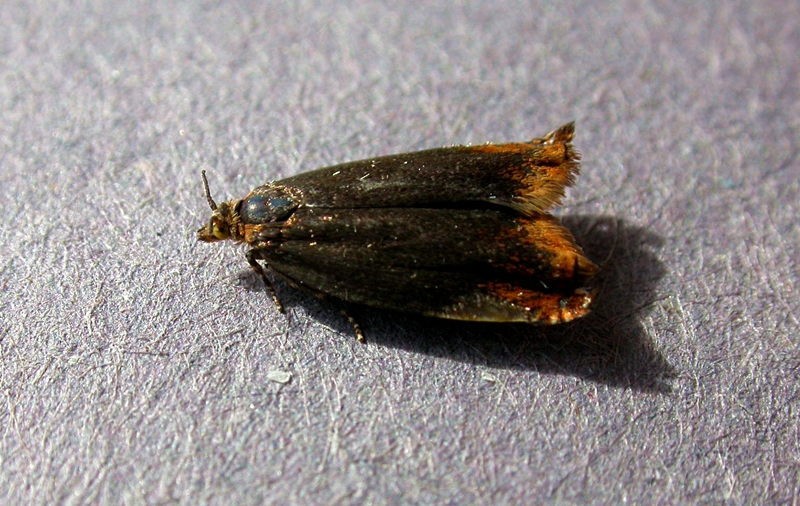
Another moth of interest was a rare moth nationally, and what appears to be only the 2nd record for VC62.  This was an Apomyelois bistriatella which has a preference for heathy areas, although this is not a habitat for which Brafferton in known.  

Apomyelois bistriatella

Apomyelois bistriatella

The next moth of interest was a fine colourful tortrix moth which I eventually narrowed down to a Gypsonoma oppressana, which even Harry said he had never seen such a colourful version.  It was interesting in that I had claimed one from Kilburn, also VC62, back in 2014, a much more typical monochrome specimen, which is also now accepted and becomes a new for VC62 predating a later accepted record.

Gypsonoma oppressana

Gypsonoma oppressana

Gypsonoma oppressana, Kilburn, VC62, 11 Jul 2014

I include a couple of macro moths, not because of their rarity, but just fabulous examples of how beautiful a 'brown' moth can be.

Mottled Beauty

Scallop Shell

Hopefully, further trapping possible in the near future.


Monday, 17 July 2017

Valerian Pug

Trapped at Hag Wood, Kilburn on 7th July 2017 and as with many pugs the photos have languished in my TBC file....  When I first potted it I was immediately struck on its lack of features not through wear but its plainness generally.  It was roughly 20mm across and once photographed I was able to study it in detail.  I cannot deny I really struggled with it.  Only for the reason it was 'plain' did I consider Plain Pug and posted an image on the Pugs Flying Tonight website where Valerian Pug was suggested.  Looking into other images of Valerian Pug I feel that this is a good call.  For what has such indistinctive features it is actually quite distinctive and there were a number of features noted on each of the web images from trusted sites; I plotted the features good for this species on one of my photos.
Valerian Pug
This is a scarce moth in the UK although reported in small numbers from most counties, it is rare in Yorkshire with last accepted VC62 record in 1913.  The foodplant is Common Valerian which according to BSBI maps does occur in the Kilburn area and I will be looking out for the plant on my next visit.

Sunday, 9 July 2017

Trapping at Hag Wood, Kilburn, VC62, night of 7th July

Yes I know, another night at Kilburn, but to be honest after such a good run of scarce moths it just had to be done.  A return to one of the original early sites I have used in the past produced 434 of 84 identifiable species.  The highlights were my first Yorkshire Beautiful Hook-tips (two) a southern species moving north into the county; two of the larch feeding Ptycholomoides aeriferana, a recent arrival to the UK but now widespread in small numbers; another Olindia schumacerana, this and the last one a week before showing only a trace of the cream coloured 'belt'; four Blomer’s Rivulet and a Larch Pug.
Ptycholomoides aeriferana

Olindia schumacerana

Olindia schumacerana

Apotomos betuletana

Spilonota ocellana 

Larch Pug
A daytime walk of the site today offered a couple of Silver Y nectaring, but no other moths of interest.  

Trapping at Kilburn, VC62, night of 1st July

Having studied the Kilburn area using google Earth looking for new potential accessible habitat I decided to try some of the higher tracks below Roulston Scar to the west of the White Horse. However on arrival I found the tracks to be more like paths and none were driveable and I had not brought my wheelbarrow or sacktruck to move the equipment any distance.  Feeling thwarted on this occasion I headed back to one of the main tracks where three meet at the foot of Hood Hill and chose the NE fork and located myself on a bend surrounded by mixed conifer and broad-leaved woodland. It was quite a breezy night especially around midnight as a very weak front passed through allowing a short period of very fine drizzle before clearing.  As it turned out, a fair night with some 415 moths of 83 species including three new micros.

The three new ones were a Carpatolechia fugitivella, an wych elm feeder, a very faded Epinotia tedella and a white marked rather than yellow Pammene regiana (awaiting gen.det.)  Each took some time to identify for different reasons: the first is not illustrated in Sterling and Parsons and I just stumbled across it while looking for something else on the internet; the second appeared non-descript but the faint marking matched similar images online including the buffy head colour and the white 'nick' in the trailing edge of the wing; and finally the Pammene patch colour is usually yellow or cream but white ones do appear in various photo libraries. 
Carpatolechia fugitivella

Epinotia tedella

Pammene regiana
The best of the rest included Larch Pug, another Clouded Magpie, seven Blomer's Rivulets, all confirming the mix of broad-leaved trees including Elm and various conifer trees including Larch and Norway Spruce.  A small selection of other species trapped are included below.

Eucosma cana

Dichrorampha acuminatana

Brown China-mark

Shaded Broad-bar

Double Square-spot

Saturday, 10 June 2017

Update 2 on the Kilburn micros

Harry Beaumont has gen.det. the four micros I sent and offered a speedy response.  The good news is that the Ancylis upupana is confirmed and two others were identified as Epinotia tetraquetrana and Bactra lancealana both males.  

The slight disappointment and one I thought would be less of a problem was the Pammene populana. Harry kindly commented "The Pammene turned out to be more of a problem. The moth looks OK for P. populana but the male genitalia were not entirely consistent with that species. These small dark Pammene species are not easy and both Charlie and I struggle with them sometimes. I have slide mounted the gen. and will compare it with my slides of other species as I get time. One of the problems is that the characteristics between species appear to vary depending which book one uses." Oh well...still hope then.  Many thanks as always to Harry!

Tuesday, 6 June 2017

Update on the Kilburn micros...

The good number of rarities caught at Kilburn on 31st May and 1st June have certainly caused some interest.  In order to get some records accepted, photos are just not enough and several moths were collected and have been sent for dissection and confirmation.  I do struggle with the concept of having to retain some species but reconcile the fact that in proving a rare species does occur that undoubtedly there are others present and adds weight to conservation requirements for a given site. One species I trapped on both nights and have only just put a name to it and the photos have been accepted: this is Ancylis upupana which is another Yorkshire rarity and of great interest as being right on the northern edge of distribution on what is a rare moth nationally.
Ancylis upupana
Of the other rarities trapped the photos of Phylloporia bistrigella and Epermenia falciformis were both considered acceptable, and although the photos certainly suggested Blastodacma atra and Pammene populana both needed genitalia determination for confirmation.  Unfortunately the B. atra was released but the other is winging its way to H.E.B. for determination and hopefully acceptance.  

Monday, 29 May 2017

Hood Hill, Kilburn, VC62, night of 26 May

Things starting to pick up a bit and a good night at Kilburn with 397 moths of 61 species.  By far the most numerous was Common Lutestring with 130, and there were an interesting selection of scarce micros including Denisia similella, Ancylis mitterbacheriana, Epinotia rubiginosana and Eucosmomorpha albersana each of which with very few VC62 records.
Denisia similella

Carpatolechia proximella

Capua vulgana

Ancylis mitterbacheriana
Epinotia rubiginosana

Eucosmomorpha albersana

Grey Pine Carpet

Foxglove Pug

Welsh Wave

Grey Birch

A rather belated catch-up...

Night of 8th April, Pilmoor, VC62 - 83 of 23 species:  the highlights being a Phyllonorycter sp, probably ulmifoliella, and the earliest Yorkshire record of Scarce Prominent.
Scalloped Hook-tip

Double-striped Pug

Scarce Prominent

Red Swordgrass

Red Swordgrass


Night of 6th May, Pilmoor, VC62 – 13 of five species, a shortened night due to being rather cool and non-productive.
Lunar Marbled Brown

Night of 12th May, Hag Wood, Kilburn, VC62 – 107 of 39 species, the highlights included the spectacular micromoth Ethmia quadrillella.
Zelleria hepariella

Ethmia quadrillella

Ethmia quadrillella

Acleris hastiana

Brindled Pug

Thursday, 28 July 2016

Trapping at Hood Hill, near Sutton Bank, N Yorks, 23rd July

After a moth-free week in Croatia, just not possible in the resort and actually few moths seen in the car headlights, I was determined to spend Saturday night out locally in Yorkshire.  The weather was just right, calm and only high cloud, and the temperature still +24 degrees at 2200, dropping no lower than +14 by dawn.  I chose a new site just below Sutton Bank on the southern fringes of the NY Moors, at Hood Hill, part of the wooded ridge near Kilburn. Not a bad night at all with 826 moths of 110 species identified, of which one was new, and a further two were new for me in Yorkshire and a further two tortix are awaiting final identification.

The first new record for me was a Batia lunaris, a species scarce in VC62 with only single figure records reported.   
Batia lunaris
The first new for Yorkshire was Dingy Shell, a species I have not seen for 10 years since leaving Dorset, and fairly local in Yorkshire, so a count of nine was of note.  This photo was taken with my phone and composed so as to show the moths characteristic wings closed stance as well as a bit of the habitat in the background.
Dingy Shell
The second new Yorkshire one was the micro-moth  Cherry Fruit Moth which was quite common with 33 counted, obviously a Cherry tree in the close vicinity!  
Cherry Fruit Moth
Diamond-back Moths were still in evidence with ten counted.  A full list of the night's catch will be added shortly once any outstanding identifications are resolved.

Saturday, 4 June 2016

A week off...at last

The first break since last autumn and a week I have taken regularly as it covers both my birthday and Em's, and for years has been a remarkably good week weather-wise.  This week just had to be different.  No rain, often cloudy but a week of insistent cold northerly wind kept the temperature well down.  Only two nights of the week were appealing enough to go out trapping, Saturday 28th May and Friday 3rd June; the first at Kilburn was calm but got down to +5 and few moths, while the second at Silton Forest was down to +11 but a stiff cold wind wind kept things rather subdued.

Kilburn, 28th May 2016

49.028  a moth (Syndemis musculana)  1
69.003  Poplar Hawk-moth (Laothoe populi)  3
70.049  Garden Carpet (Xanthorhoe fluctuata)  1
70.054  Silver-ground Carpet (Xanthorhoe montanata)  1
70.075  May Highflier (Hydriomena impluviata)  1
70.094  Small Phoenix (Ecliptopera silaceata)  5
70.100  Green Carpet (Colostygia pectinataria)  1
70.183  Common Pug (Eupithecia vulgata)  1
70.207  Clouded Border (Lomaspilis marginata)  1
70.222  Brown Silver-line (Petrophora chlorosata)  3
70.223  Barred Umber (Plagodis pulveraria)  1
70.240  Scalloped Hazel (Odontopera bidentata)  2
70.270  Engrailed (Ectropis crepuscularia)  2
72.015  Pale Tussock (Calliteara pudibunda)  3
73.329  Flame Shoulder (Ochropleura plecta)  1

May Highflyer
Common Pug
 Silton, 3rd June 2016

07.006  a moth (Adela reaumurella)  1
15.008  a moth (Caloptilia alchimiella)  1
18.001  Diamond-back Moth (Plutella xylostella)  3
49.028  a moth (Syndemis musculana)  2
49.254  a moth (Epinotia bilunana)  1
69.003  Poplar Hawk-moth (Laothoe populi)  3
69.016  Elephant Hawk-moth (Deilephila elpenor)  1
69.017  Small Elephant Hawk-moth (Deilephila porcellus)  1
70.051  Red Twin-spot Carpet (Xanthorhoe spadicearia)  1
70.075  May Highflier (Hydriomena impluviata)  1
70.086  Broken-barred Carpet (Electrophaes corylata)  1
70.094  Small Phoenix (Ecliptopera silaceata)  1
70.222  Brown Silver-line (Petrophora chlorosata)  4
70.240  Scalloped Hazel (Odontopera bidentata)  5
70.277  Common White Wave (Cabera pusaria)  1
70.280  Clouded Silver (Lomographa temerata)  1
71.012  Iron Prominent (Notodonta dromedarius)  1
71.018  Lesser Swallow Prominent (Pheosia gnoma)  1
72.015  Pale Tussock (Calliteara pudibunda)  5
72.019  Buff Ermine (Spilosoma lutea)  3
72.020  White Ermine (Spilosoma lubricipeda)  4
73.264  Pale-shouldered Brocade (Lacanobia thalassina)  6
73.271  Broom Moth (Ceramica pisi)  1
73.272  Glaucous Shears (Papestra biren)  1
73.329  Flame Shoulder (Ochropleura plecta)  6
73.334  Small Square-spot (Diarsia rubi)  1

Broken-barred Carpet
Small Elephant Hawk-moth
Pale-shouldered Brocade

With such an influx of Diamond-back Moth into the country over the last week it was good to have trapped three at Silton and two more seen at Aldborough during the day today.  I should mention that while driving to Silton last night there were many thousands of small moths seen in the car headlights which may well have been this species but only a few caught in the trap due to the strong breeze?