Welcome:

Welcome to my world..............

Friday, 28 June 2013

Perks of the job...

What an odd start to the year.  The cool spring, hardly any moths on the very few nights out trapping, and something called work getting in the way of night-time trapping.  With a mileage in the last ten days the equivalent of driving from here to Athens and back, in a mixture of vehicles, the cream has to be three of these in this week alone.....unfortunately I did not get a photo of the black Vantage.
Aston Martin DBS

Aston Martin Vantage
The DBS was picked up in Bristol and returned to Boroughbridge...unfortunately due to the M1 closure just had to take the long way round via Manchester...  As much as a huge pleasure it was to drive, I cannot help thinking that a six litre V12 engine probably has contributed to the extinction of several species on this journey alone!

Saturday, 27 April 2013

Spring has sprung!

What a difference a week makes.  After such a cold start to the year, a touch of sun seemed to spur the hedgerows into life and the first real flush of green was very noticeable.  I saw my first butterflies of the year, a Brimstone and a couple of Peacocks early in the week, plenty of Swallows, House Martins and Sand Martins over the River Ure, Chiffchaffs singing everywhere.  So the promise of a mild evening on Tuesday (23rd  April) meant dusting off the moth trap, the first trapping session since what seemed the last mild night back in early January.
So, off to that old favourite, Pilmoor, on the old railway line, and in four hours trapping managed a very creditable total of 300 moths of 20 species.  No real surprises, the majority of the moths were Diurnea fagella a common birch-feeder, a few Orthosias, and a handful of Eriocrania sp., but did include one of my favourite spring moths, a Streamer.
Semioscopis steinkellneriana

Streamer

Water Carpet - f. piceata

Pale Pinion

Tuesday, 19 March 2013

Black sheep.....

The last eight weeks or so have been extremely busy on a couple of projects.  The first is the development of the new Dorset Moths website - more of that to follow when open for business!  The other project over the last three weeks when my elderly Mother was staying with us and we were going through many old photos which she had brought over from Ireland at my request.  One photo that started me thinking was an old one which I thought was me with my Grandad Box but which turned out to be my Dad, his Dad, Grandmother and Great Grandmother in Normanton about 1940.
David Allen Box, William Edward Box, Annie Box (nee Speight) and Katherine Speight (nee Rayner).
This got me on to looking at the four branches of the family tree; the Denyer (Sussex) and Lane (Reigate, Surrey) families on my Mothers side and the Box (Newcastle-under-Lyme and Normanton, Yorkshire) and Deyes (Yorkshire) on my Fathers side.  I got back to 1695 on the Box side and 1610 on the Denyer side and just keeping the tree fairly tight managed to get 427 people with 72 unique surnames.  It is amazing how starting with me that over 13 generations how quickly the tree spread out, and the only way I have managed is using the GRAMPS (no relation!) software.  

The Denyers of Bersted, Bognor, with my Grandad on the right. c.1920

The Deyes and Taylor families, 1st Jan 1903, Normanton, Yorkshire

Irene Denyer, William Denyer, Mabel Denyer, Ann Denyer (my Mum), Arthur Lane and Marjorie Lane. c.1942
I could not get over how many people were born, lived their lives and died all in the same small place.  On several occasions I spotted other families names on the same census pages of people who would end up marrying.  Most of the Denyers were in and around Bognor Regis, but a couple ended up moving to South Shields as sailors (one having a rather colourful sub-ordinate military record)  followed some years later by one of the Denyer girls travelling up and marrying a cousin (I was stumped by two with the same surname getting married....).  The Boxes were centred on Newcastle-under-Lyme and there were several entries for the Stafford Courts with one given 7 years and transportation to Tasmania for nicking lead off a roof and some years later his son of the same name getting a 6 month prison sentence for larceny.  Some of the Box family moved up to Yorkshire and were heavily involved in mining and the railways.  The miscreants aside, of the rest not all lived successful and fulfilling lives with one killed in action in Flanders, another ending up in the Doncaster Workhouse, and another getting injured as a policeman in Leeds and then dying of TB two weeks after his daughter my Nan was born.

So, every family has their black sheep, and I am sure that more interesting characters will appear over the coming weeks.  Fascinating stuff, and it has kept me occupied during these cold and wet days and nights although now am looking forward to catching a few moths and more regular updates.

Friday, 8 February 2013

Spoke too soon...

The 2nd-winter Iceland seen in flight twice today at Allerton, and my visit interrupted by a conversation with one of the contractors.....the pools ARE due to be filled in, progress stalled by the recent weather.  What a shame, and a wasted opportunity.

Wednesday, 6 February 2013

Allerton Tip Iceland Gull

The one advantage of these very breezy days is that the gulls at Allerton will at least be all pointing in the same direction!  This helps in looking at and assessing shades of grey and any darker (or paler) backed gulls stand out that much better.  With the winds from the north today, most of the gulls were actually rear-on, rather than the usual side-on.  No repeat of the 2nd-winter Iceland from last Friday, and the gulls were very flighty, being put up by a couple of Red Kites which looked fantastic in the low bright sunlight highlighting every hint of colour in the birds.  It soon became obvious that many of the gulls were actually in the dip the other side of the bank.  I drove round to look from the farm road parallel to the old A1, and waited for the gulls to fly up. With the sun now right behind me and the distant sky dark grey and dropping curtains of snow, when the gulls flew up they really stood out against the background.  Sure enough, the 2nd-winter Iceland Gull was soon picked out among the hundreds of Herring Gulls, and it lazily flew off to the north.
So, the threat of the first washing pit to be filled in may have passed, indeed the earth-moving equipment seem to have excavated another deeper pool just to the north of the main pit.  Perhaps my unacknowledged correspondence with the land-fill company actually worked - who knows.....

Sunday, 20 January 2013

Colour-ringed Godwits

Back in September I posted on my visit to south-west Ireland and added some photos on a couple of first-year colour-ringed Black-tailed Godwits at Roscarberry, Co Cork.  They were part of a flock of c.500 birds, mainly first-years, and the two colour-ringed birds were observed in close proximity for several hours on 19th September.  The rings are as follows:

Bird 1 on left:  Left leg - pale green over dark green    Right leg - red over yellow flag
Bird 2 on right:  Left leg - dark green over black    Right leg - yellow over yellow flag

Black-tailed Godwits
I scoured the internet and found several addresses for people who carried out Black-tailed Godwit ringing and sent off the details.  Not having heard anything I rather gave up hope, but out of the blue I received an email this morning from a Peter Potts with details on the birds.  Both birds, as suspected, were Icelandic, having been ringed there earlier in the year.  Their ringing details are as follows:

Bird 1 on left:  ringed in the southern lowlands of Iceland - details to follow.
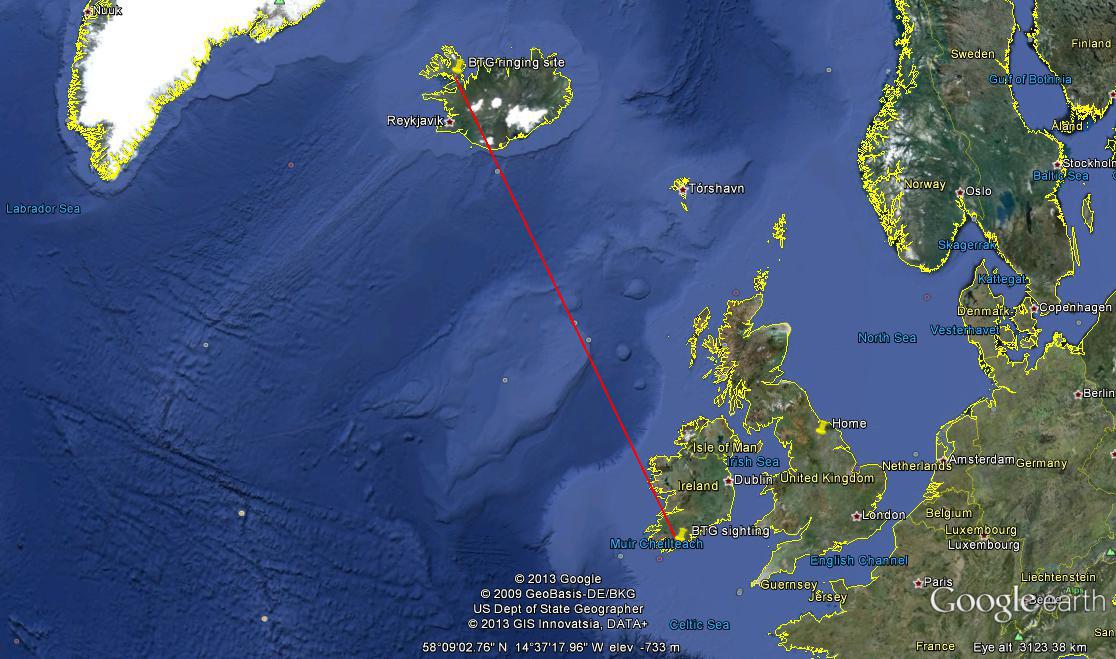
Bird 2 on right:  ringed on 1st July 2012 at Klettur, road 60 north of Kroksfjardarnes in NW Iceland at 65 28 976'N 21 56.631'W.
Ringing site, photo P Potts
Ysbrand Galama and Dan Hoare, photo P Potts

Bird 2 in the hand, photo P Potts
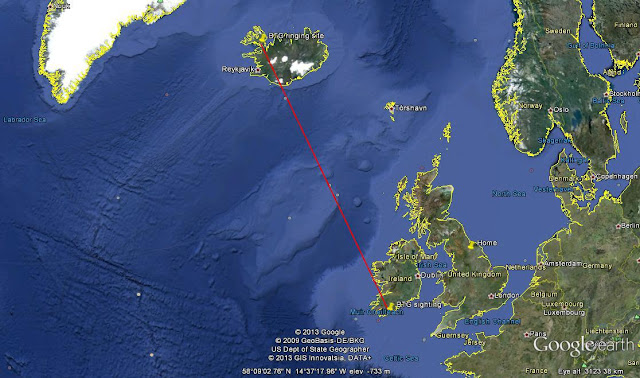
1700km from ringing site to where I saw it in Ireland


Monday, 31 December 2012

2012 and all that...

Far too long since the last post, although to be fair I have been rather unwell for five weeks and just not had the energy or inclination to do anything demanding on the computer let alone go out and do some natural history watching!

So, 2012, a year of ups and downs at best, and continues the run of cloudy and often unsettled weather of the last six years, due to the more southerly path of the jetstream.  Presumably as a direct result of the shrinking polar icecaps and unlikely to reverse anytime soon, and rather depressingly a portender of summers to come.

On the ornithological front, probably the worst in 40 years of active birdwatching.  Other than the occasional visit to Nosterfield, watching the gulls at Allerton and a brief few days in Ireland, the impetus to get out and about has been further dulled by the modern birding scene and obsession with rarities, and opinionated mediocrity.  The few highlights were the decent run of white-winged gulls in the spring, fantastic regular views of Red Kite, dawn-choruses of waking marshland birds at Staveley, some decent seabirds and wonderful Choughs on the Irish west coast and the only BB rarity of the year, a Semi-P on a beach in Ireland.  Hardly a vintage year.
Red Kite
A productive year on the moth front with just under 10,000 identified of at least 435 species, despite coverage during the year being very patchy.  No trapping was attempted during the very wet April into mid May, mid August to early September, and thereafter were just single visits to Pilmoor in mid-October and November.  The range of sites was much more restricted this year, concentrating effort on the sites closer to home, mainly Pilmoor and Sessay area and Staveley; there were no visits to my usual sites on the North Yorkshire moors or visiting under-recorded 10km squares around the county.  With 36 nights out against 45 in 2011, the reduced number of sites and the gaps in coverage, makes the totals achieved rather more respectable.  There were five macro-moths which were new to me, and about 35 new micros, their identification assisted greatly with the new book by Sterling and Parsons, and the status and distribution of moths in the county made available for the first time on the Yorkshire Moths website. Referring to the website, which currently is up-to-date to end of 2011, I have tentatively applied some figures to my rarer catches.

481 Epermenia falciformis 1st VC62
849 Syncopacma cinctella 2nd VC64 and 3rd Yorkshire
854  Anacampsis blattariella 5th VC62
878  Batrachedra praeangusta 5th VC62
930  Gynnidomorpha alismana 1st VC64 and 6th Yorkshire
968  Cochylis nana 3rd and 4th VC62
1086  Hedya salisella 4th and 5th VC62 (the 3rd was mine too)
1089  Apotomis semifasciana 4th to 8th VC62 (all the others are mine)
1104  Endothenia quadrimaculana 5th to 8th VC64
1106  Lobesia reliquana 1st and 2nd VC62 and 7/8th Yorkshire
1123 Ancylis laetana 3rd to 7th VC62 (all of which are mine, one other site in Yorkshire)
1132  Epinotia subocellana 2nd VC62
1135  Epinotia demarniana 6th to 12th VC62 (all VC62 records mine from 1 area and confirmed)
1137  Epinotia tetraquetrana 3rd VC62 and 4th VC64
1217  Eucocosmomorpha albersana 2nd Yorkshire record since 1987, the 1st was mine in 2011, a handful
of older records
1225  Pammene obscurana 2nd VC62 and 5th Yorkshire (I had 1st VC62 too)
1348  Parapoynx stratiotata 2nd VC64
1473  Ephestia elutella 1st VC65 and 12th Yorkshire
1517  Adaina microdactyla 5th VC64
1523  Oidaematophorus lithodactyla 3rd VC64

Once all of the 2012 records are included and published in the Yorkshire database some of these figures may have to be updated, but it is certainly an indication of the quality of the years trapping.

My moth of the year?  Well, it has to be this one, a Bordered Pug at Staveley, not particularly rare but a stunning pug all the same.  This was followed very closely by the remarkable sight of six Lunar Thorns together at Brimham, my only previous ones being a single at Brimham and one in my Dorset garden.

Bordered Pug
What for 2013?  Other than the pressing requirement to achieve a more stable economic base for the family, I look forward to concentrating my efforts locally again, with perhaps also some selective effort on the southern fringes of the NY Moors, and looking at other orders to broaden my interests.