Having been birding seriously for over 45 years there have been many occasions when the effort of going out has been rewarded with those outstanding and wholly memorable moments. Having been a patch watcher for most of that time those special rewards have been many if not particularly meaningful to others, with many hours spent watching Cheddar Reservoir, Brean Down and the Somerset Levels. Those long gone years of chasing other people’s bird do not even get a mention in this list, indeed the only twitchy bird was the Wallcreeper but this was well before the news broke and invariably I was the only one present.
There are many events and birds that stick in my mind but assembling this list of the top ten was surprisingly easy; they just all sprang to mind in an instant. Self-found birds are always a thrill and there are many instances of the pleasure of finding species new for the site. Overseas trips do offer the opportunity to find plenty of interesting birds, even common species which you don’t often see in the UK. These days the modern birding scene in Britain is not at all enjoyable, and I long for overseas holidays to enjoy the local birds in the peace and quiet with always the possibility of something new.
My list of top ten birding moments follows, in no particular order, although those months of solitary viewing of the Wallcreeper must be near the top:
Wallcreeper at Cheddar
I had only heard a rumour the first winter the bird was present and chased over to Hastings in Spring 1978 to miss the bird there by a couple of hours. Subsequently the news broke about it having been in a quarry at Cheddar, Somerset where I was living at the time: I could even see the quarry from my bedroom window. The following Winter I was tipped the wink that the bird had returned but that the quarry owners would not entertain general public access. Over the following months I saw the bird dozens of times, in at least three different locations, usually by myself or with my best mate. Cheddar Gorge was the most difficult site and the bird was always distant, Chelms Combe Quarry was the main site and occasionally gave close views, and Shipham Gorge quarry gave the closest views on one occasion. Once the news broke, Chelms Combe quarry and the tower-testing station became overwhelmed, but I cannot imagine how the whole area would grind to a halt if it was repeated now. Towards the end of its stay the bird was moulting into breeding plumage developing a black throat and how can I ever forget it singing the plaintive notes while hopping in and out of a puddle on the rockface!
Christmas morning Oued Massa
Having already been to Morocco in the usual spring time several years earlier, I jumped at the chance of a Christmas trip there with three other guys from Somerset in December 1982. There were lots of stunning birds which were new to the others and Lammergeyer was new to me. However the bird of the trip was a White-tailed Plover I flushed from a flooded field at Oued Massa on the Atlantic coast. The following morning after waking on the beach at Oued Massa, from my sleeping bag a flock of Bald Ibis flew north above the surf. There were many Crested Coots, Marbled Teal among the thousands of wintering duck, Audouin’s Gulls on the beach, Moussier’s Redstarts and Black-capped Tchagra in the scrub, Plain Sand Martins overhead and further fabulous views of the Plover. What a Christmas present!
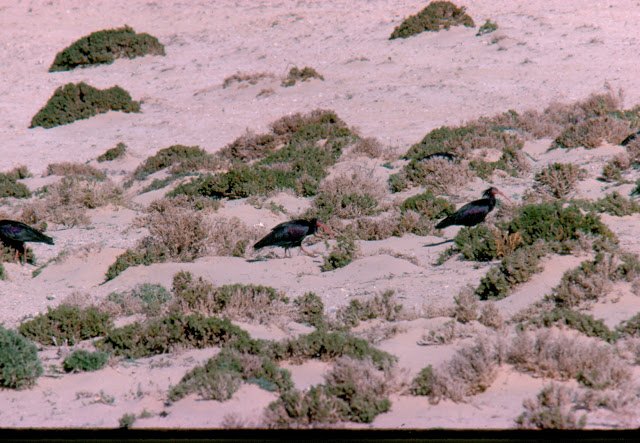 |
| Bald Ibis, on the beach, near Tamri, Morocco |
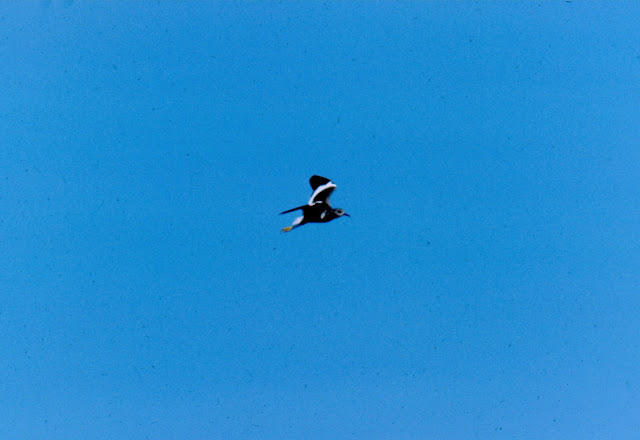 |
| White-tailed Plover, Oued Massa, Morocco |
Monterey pelagic trip
This has always been a lifelong ambition to do and had a fantastic experience in August 2014, and this is covered in detail in my blog at that time. If you ever get the chance just do it!
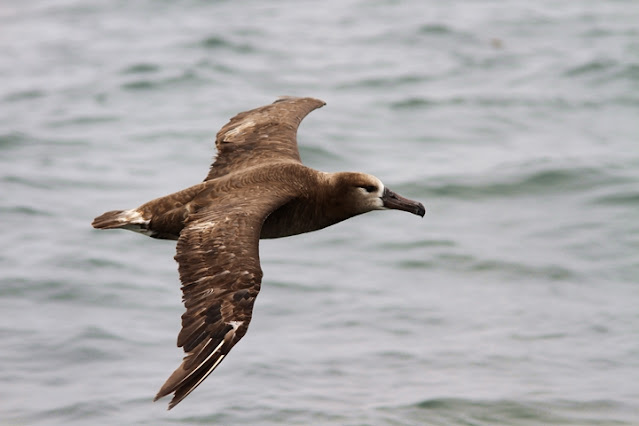 |
| Black-footed Albatross, Monterey |
UAE
I have been fortunate to spend a couple of long weekends in the UAE, once in Spring and again in the Autumn. What a fantastic place to see lots of birds and some real cripplers in beautiful scenery and great light. The estuaries offered up fantastic views of thousands of waders, breeding plumage Greater and Lesser Sandplover, Great Knot, Crab Plover, Broad-billed Sandpiper, Pacific Golden Plover and Terek Sandpipers. There were plenty of bewildering races of gulls, including summer-plumaged Great Black-headed Gulls, Crested, Lesser Crested and White-cheeked Terns. An absolutely stunning country and one I would love to return to.
Fall of yank warblers Point Pelee
Early May 1979 at Canada’s premier migration hot-spot Point Pelee was a fantastic experience. I think there were 12 of us in our rented house and the early morning walks around the point was a mind-blowing introduction to American birds, particularly the warblers. No matter where you looked the trees and bushes were crawling with birds and I spent many hours tracking down the species present. Having had all my kit stolen in America two months later I no longer have the photos or notebooks so recollections are a little hazy. However I do know that it was possible to see over 30 species of warbler in a day in their stunning breeding plumage, and on one occasion nearby at Rondeau having a crippling male Prothonotary Warbler actually perched on my boot, far too close to photograph!
Phassouri reed-beds Cyprus
In July/August 1982 I spent a fantastic couple of moths birding in Cyprus. The hot summer months are not that well covered by visiting birders so there was plenty of scope for interesting records. One of my favourite sites was Phassouri reed-beds on the Akrotiri peninsula. From the very first visit it was obvious that there were birds there not usually recorded in Summer: these included Night Herons which were seen carrying food into the reeds, at least three Little Bitterns including a juvenile, up to six Baillon’s Crakes all but one were juveniles, Great Reed Warbler a pair feeding young, and Penduline Tits calling and seen frequently in the reeds. All were either breeding or strongly suspected of breeding and the records were sent to Messrs Flint and Stewart who were preparing the updated Birds of Cyprus. Thankfully most of the sightings just made it into the new book. How can I forget sitting in a very hot and cramped canvas hide photographing some of these birds, with a Baillon’s Crake scratching at the canvas at my feet and a singing Great Reed Warbler sitting inches above my head on top of the hide.
Silver Jubilee
This long weekend falling in the first week of June 1977 proved an exciting few days for a couple of then low-listers. A route was planned for Andy and I in his trusty MGB which would offer us some new birds. Virginia Water for Mandarin Duck, Stodmarsh for Cetti’s and Savi’s Warblers and then up to the Brecks: Golden Pheasant, self-found male Montagu’s Harrier, Golden Orioles and Stone Curlew. Minsmere produced a fine adult Woodchat plus the usual wetland birds, Red-backed Shrike nearby and then the Ouse Washes to see an adult female Wilson’s Phalarope and a flyby Pratincole which only a handful of us saw. Unfortunately I had to return a couple of days before Andy and he went on to summer plumaged White-winged Black Tern and Honey Buzzards in North Norfolk. I think the following weekend I passed the 200 mark on my British list but as a weekend I do not think I have seen so many quality birds in such a relaxed atmosphere, good company and great weather.
Purple Heron Cornwall
I was spending a few days on the Lizard with Andy in May 1988. Mid-afternoon following a moment for delirious premonition mixed with wishful thinking we announced we were off to Gunwalloe reedbed to see a Purple Heron which at that time was new to both of us. Gunwalloe has always been one of my favourite Cornish sites and we arrived to walk up the reedbed and had great flight views of a Hoopoe and loads of newly arrived summer visitors. I was amazed to see what was clearly and adult Purple Heron launch itself from the reedbed and fly up the valley before dropping down. What a fantastic view of such a great bird in a fabulous place, but such wishful thinking on subsequent occasions has not proved so fruitful…..
Cream-coloured Courser in Spain
In the August of 2001 on a family holiday to southern Spain, based at Zahora, near Cape Trafalgar in a part of Spain the Spanish went on holiday and with very few English (with the exception of the villain Kenneth Noye who was hiding there). An estuary nearby at Barbate was an attraction for the big flock of Stone Curlew but on one visit I was amazed to see two Cream-coloured Coursers, one of my favourite birds. The habitat was stony sand with small clumps of low scrub and was very reminiscent of the places I had seen them in North Africa. There were only a handful of Spanish records at that time but subsequently found out that a pair had bred elsewhere in southern Spain the same year.
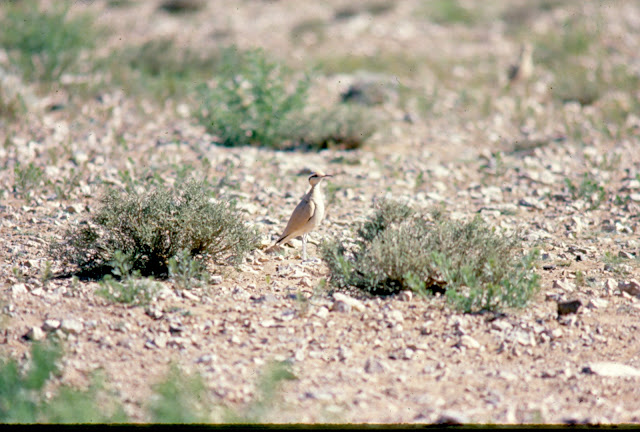 |
| Cream-coloured Courser, a Moroccan one rather than Spanish... |
Oukeimeden
Morocco is one of my favourite places and had two fortnight trips there and a couple of long weekends. On one of the weekend trips to Marrakech in March 2005, I had spent a day at Oued Massa and Oued Sous and then fought my way over the mountains and spent on of the coldest nights I can remember sleeping in the car at the Atlas mountain ski resort of Oukeimeden. Always a pleasure to visit but how can I ever forget waking up to see Crimson-winged Finch on my wing-mirror, hundreds of Rock Sparrows on most buildings and Alpine Choughs flying over. On driving down the mountain I at last caught up with the endemic Levaillant’s Green Woodpecker something I had missed on three previous visits. It was calling and I rang my mate Andy hoping he could hear it….